
The Parts Under Your Hood: A Plain-English Map
Confused by what's under the hood? This guide names and explains every major engine component in language any driver can understand.
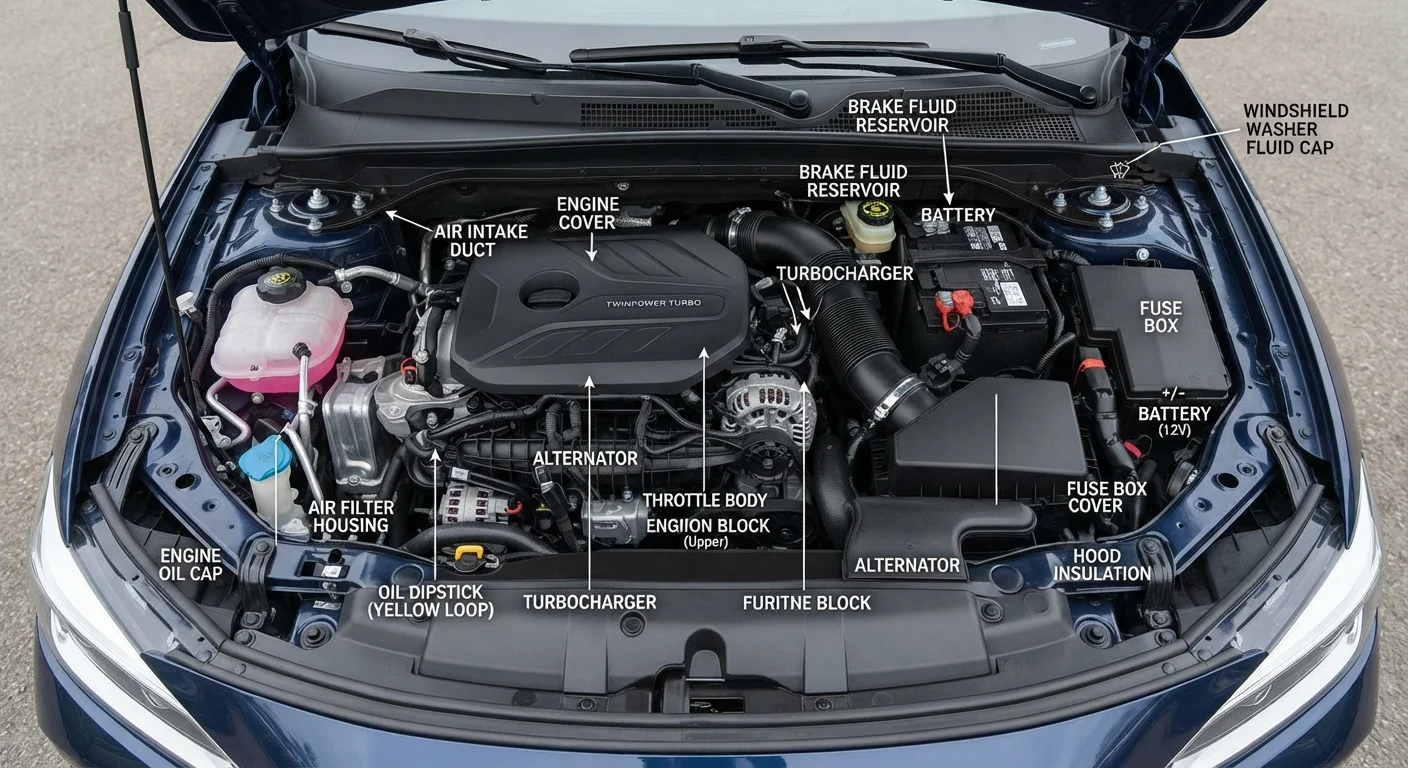
Photo: FaqsDrive.com | Smart Way To Search editorial
—— In This Article
Key Takeaways
- The engine block is the central structure housing the cylinders where fuel combustion occurs.
- Several support systems - cooling, lubrication, and electrical - keep the engine running safely.
- Air and fuel must mix in precise proportions; the exhaust system removes combustion waste.
- Recognizing component names helps you communicate effectively with mechanics and respond to warning lights.
- Most engine inspection tasks require a qualified mechanic; visual familiarity is your foundation.
Why It Pays to Know Your Engine
Opening your hood for the first time can feel like staring at a foreign language - a tangle of hoses, metal, and plastic with no obvious meaning. That unfamiliarity has real costs. Drivers who can't name basic engine components often struggle to describe problems accurately to mechanics, miss early warning signs, and feel less confident evaluating repair quotes.
You don't need to become a technician. What you need is a reliable mental map - enough vocabulary to ask smart questions and understand the answers. This guide builds that map, component by component. Once you've finished, you'll be ready to take the next step with our guide to talking with a mechanic.
The Engine Block and Its Core Parts
The engine block is the large cast-metal structure that anchors everything else. Inside it are the cylinders - hollow chambers where a controlled explosion of air and fuel pushes a piston downward with each firing. Most passenger cars have four, six, or eight cylinders.
As pistons move up and down, they turn the crankshaft, converting that straight-line motion into the rotational force that eventually spins your wheels. Sitting above the cylinders is the cylinder head, which houses the valves - small gates that open and close to let air in and exhaust gases out. The camshaft controls the precise timing of those valves, and it's driven by either a timing belt or a timing chain connected to the crankshaft.
The head gasket seals the joint between the cylinder head and the block, keeping coolant and oil in their separate passages. A blown head gasket is one of the more serious engine failures a driver can face, which is why keeping cooling and oil systems healthy matters so much.
Cooling, Lubrication, and Electrical Systems
Three support systems work continuously to protect the engine from destroying itself with its own heat and friction.
Cooling System
The radiator sits at the front of the engine bay and dissipates heat by passing coolant (antifreeze mixed with water) through a network of thin tubes. A water pump circulates coolant between the engine and radiator, while the thermostat regulates coolant flow based on engine temperature. The coolant reservoir is a translucent plastic tank where you can check the fluid level visually. Learn more about checking these fluids in our practical fluid inspection walkthrough.
Lubrication System
The oil pan at the bottom of the engine stores motor oil. An oil pump pushes that oil through passages to coat moving metal parts, while the oil filter removes contaminants before the oil recirculates. Understanding what the numbers on your oil cap mean helps you choose the right oil for your vehicle.
Electrical System
The battery provides the initial power to start the engine. Once running, the alternator takes over, generating electricity to recharge the battery and power lights, sensors, and accessories. The starter motor is the small electric motor that cranks the engine during ignition.
Air, Fuel, and Exhaust: The Breathing Cycle
Every internal combustion engine follows a simple principle: mix air with fuel, ignite it, and extract the energy. Several components manage each stage of that cycle.
Intake and Fuel Delivery
Air enters through the air filter, which traps dust and debris before they can damage engine internals. The throttle body controls how much air flows into the engine - pressing the accelerator opens it wider. In most modern vehicles, fuel injectors spray a precise mist of gasoline directly into each cylinder (or just before it), controlled by the engine's computer. The spark plugs ignite that mixture at exactly the right moment.
Exhaust
After combustion, burned gases exit through the exhaust manifold, travel along the exhaust pipe, and pass through the catalytic converter - a device that chemically reduces harmful pollutants before gases exit through the muffler, which dampens sound. If any stage of this cycle is disrupted, you may see a warning light on your dashboard; our warning light quick-reference guide explains what each icon signals.
What to Do With This Knowledge
Understanding what's under your hood doesn't mean you should attempt repairs yourself. Engine work often involves high temperatures, pressurized systems, and precise tolerances that require professional tools and training. What this knowledge does is sharpen your ability to notice changes - an unusual smell, a new noise, a leaking fluid - and describe them accurately when you bring your vehicle in.
Pair this foundation with Car Maintenance 101 to understand which services keep these components healthy, and keep your owner's manual close - it specifies the exact fluids, intervals, and service requirements your vehicle's manufacturer designed it around. Confident car ownership starts with knowing what you're looking at.
Frequently Asked Questions

Automotive Basics Editorial Team
Automotive Basics Editorial Team is the collective byline for our editorial team and contributor network. Articles published under this byline or an editorial pen name are researched, written, and reviewed according to our editorial standards for clarity, consistency, and independence before publication.
View author profile