
AWD, 4WD, FWD, and RWD: What Each Drivetrain Actually Does
Drivetrain acronyms can be baffling. Understand how each system sends power to your wheels and what that means for everyday driving.
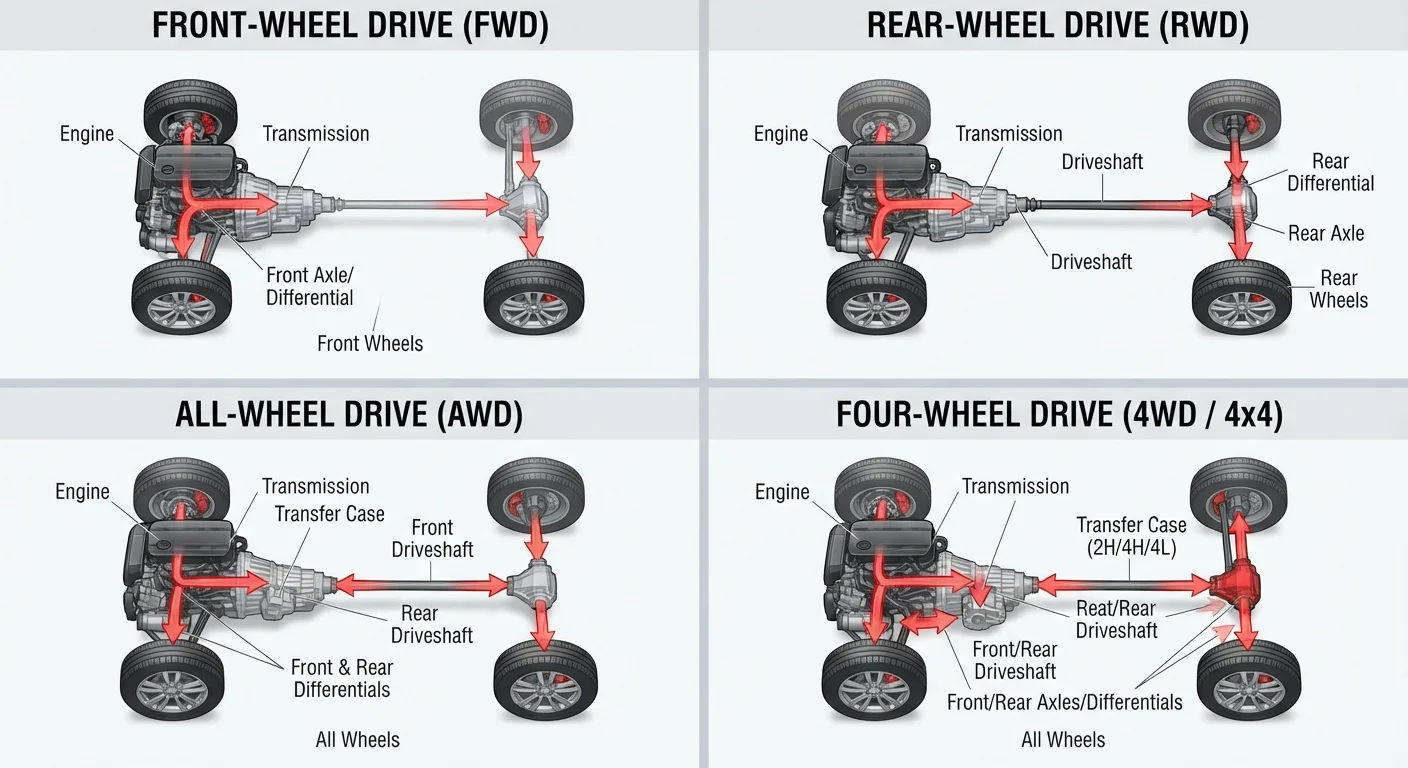
Photo: FaqsDrive.com | Smart Way To Search editorial
—— In This Article
Key Takeaways
- FWD is the most common and fuel-efficient drivetrain, ideal for everyday commuting in moderate climates.
- RWD offers a balanced feel favored in performance and towing applications but can struggle in snow.
- 4WD is a rugged, driver-activated system designed for serious off-road and low-traction conditions.
- AWD runs automatically and improves grip on slick roads, but does not replace safe winter driving habits.
- No drivetrain eliminates the need for proper tires and appropriate driving behavior in bad conditions.
Why Drivetrains Matter More Than Most Drivers Realize
When you press the gas pedal, your engine generates power - but how that power reaches the road depends entirely on your drivetrain. The drivetrain is the system that transfers engine output to one or more sets of wheels. Get this wrong when choosing a vehicle, and you may find yourself underpowered in snow, burning extra fuel on a daily commute, or unable to handle the towing job you planned for.
The four main drivetrain types - FWD, RWD, AWD, and 4WD - each route engine power differently. Understanding what each one actually does helps you make a smarter vehicle choice and a more informed driver. For a broader look at what's physically happening beneath your vehicle, see our plain-English guide to what's under the hood.
FWD and RWD: The Two Foundational Systems
Front-Wheel Drive (FWD) sends power exclusively to the front two wheels, which also handle steering. Because the engine, transmission, and driven wheels are all clustered at the front, FWD vehicles are relatively lightweight and mechanically simple. That translates to better fuel economy and lower manufacturing costs - which is why FWD dominates sedans, minivans, and compact SUVs. FWD also provides decent traction in light snow because the weight of the engine sits directly over the driven wheels.
The trade-off is a phenomenon called torque steer - a tendency for the steering wheel to pull under hard acceleration - and a somewhat nose-heavy feel during spirited driving.
Rear-Wheel Drive (RWD) routes power to the back wheels while the front wheels steer freely. This separation of duties creates a more balanced weight distribution, which is why RWD is the standard choice for sports cars, muscle cars, full-size trucks, and larger body-on-frame SUVs. RWD also makes towing easier, since the driven wheels are closer to where load is applied.
The well-known downside: RWD can be harder to manage on snow or ice, because the back wheels can lose grip and cause the rear of the car to slide sideways (oversteer). Skilled drivers can manage this, but winter tires are especially important on RWD vehicles in cold climates. For tips on handling slippery conditions, see our guide to driving in rain, snow, and fog.
AWD vs. 4WD: Similar Names, Different Jobs
This is where most confusion happens. AWD and 4WD both send power to all four wheels, but they work in fundamentally different ways and serve different purposes.
All-Wheel Drive (AWD) operates continuously and automatically. The system monitors wheel slip in real time and distributes power between the front and rear axles - and sometimes between individual wheels - without any driver input. Most modern AWD crossovers and sedans use this approach. It's seamless and highly effective on rain-slicked highways, light snow, and mixed-surface roads. AWD is an on-road traction tool, not an off-road one.
Four-Wheel Drive (4WD) is a more mechanically robust system traditionally found on trucks and body-on-frame SUVs. In many vehicles it must be manually engaged (via a lever, dial, or button) and adds a transfer case - a gearbox that locks the front and rear driveshafts together so they spin at the same speed. This rigid connection maximizes grip in deep mud, sand, or rocks, but makes the system unsuitable for regular road use in 4WD mode because it can stress drivetrain components on firm pavement. Many modern 4WD trucks include a part-time 4WD mode for off-road plus an automatic mode for light-duty traction assistance.
| FWD | RWD | AWD | 4WD | |
|---|---|---|---|---|
| Wheels powered | Front two | Rear two | All four (auto) | All four (selectable) |
| Typical vehicles | Sedans, compact SUVs | Sports cars, trucks | Crossovers, wagons | Trucks, off-road SUVs |
| Fuel efficiency | Highest | Moderate | Lower than FWD | Lowest |
| Snow/wet road traction | Decent | Weakest | Strong | Strong (when engaged) |
| Off-road capability | Limited | Limited | Moderate | Strongest |
| Driver action required | None | None | None (automatic) | Often manual engagement |
| Towing suitability | Low-moderate | High | Moderate | High |
It's worth noting that AWD does not make a vehicle immune to skidding or stopping distances. Physics still apply - AWD helps you go, but stopping and steering remain governed by your tires and your inputs. The braking system works the same regardless of drivetrain.
Tires Do More Work Than Your Drivetrain
Many drivers assume upgrading from FWD to AWD solves winter driving problems. In reality, the tires contacting the road are your primary safety tool in snow and ice. A set of quality winter tires on any drivetrain will typically outperform an all-season-equipped AWD vehicle in severe cold. Consider your tire choice before assuming you need a different drivetrain.
How to Choose the Right Drivetrain for Your Situation
Start with your actual driving environment, not the marketing language on a window sticker.
~65%
U.S. new vehicles sold with FWD or AWD
Industry data consistently shows front- and all-wheel-drive configurations dominate new vehicle sales in the U.S., reflecting consumer preference for everyday traction.
25-50%
Reduction in traction loss with winter tires vs. all-seasons
Tire safety organizations have reported that switching to dedicated winter tires can dramatically outperform drivetrain upgrades alone in cold-weather stopping and cornering.
- Mild-climate commuters: FWD covers the vast majority of needs at the lowest cost and best fuel efficiency. Most compact and midsize cars in this category serve drivers well for decades.
- Snowy or hilly regions: AWD (combined with proper winter tires) adds meaningful confidence. But tires matter more than drivetrain - a FWD vehicle on winter tires often outperforms an AWD vehicle on all-season tires in deep snow.
- Towing, hauling, or off-roading: A 4WD truck or truck-based SUV is the purpose-built answer. AWD crossovers are not designed for sustained off-road stress.
- Performance or driving feel: RWD provides a more engaging, balanced driving dynamic for those who prioritize the experience behind the wheel.
Drivetrain choice also interacts with fuel economy and maintenance costs. AWD and 4WD systems add weight and mechanical complexity, which can reduce efficiency and add service points over time. Understanding how the transmission works alongside your drivetrain also helps - see our comparison of transmission types for that layer of the puzzle. And if you want to understand how power output relates to real-world performance, our explainer on horsepower vs. torque breaks it down clearly.

Automotive Basics Editorial Team
Automotive Basics Editorial Team is the collective byline for our editorial team and contributor network. Articles published under this byline or an editorial pen name are researched, written, and reviewed according to our editorial standards for clarity, consistency, and independence before publication.
View author profile