
Transmission Types: Manual, Automatic, CVT, and Dual-Clutch Side by Side
From stick shifts to CVTs, each transmission works differently. See how they compare on feel, efficiency, and long-term reliability.
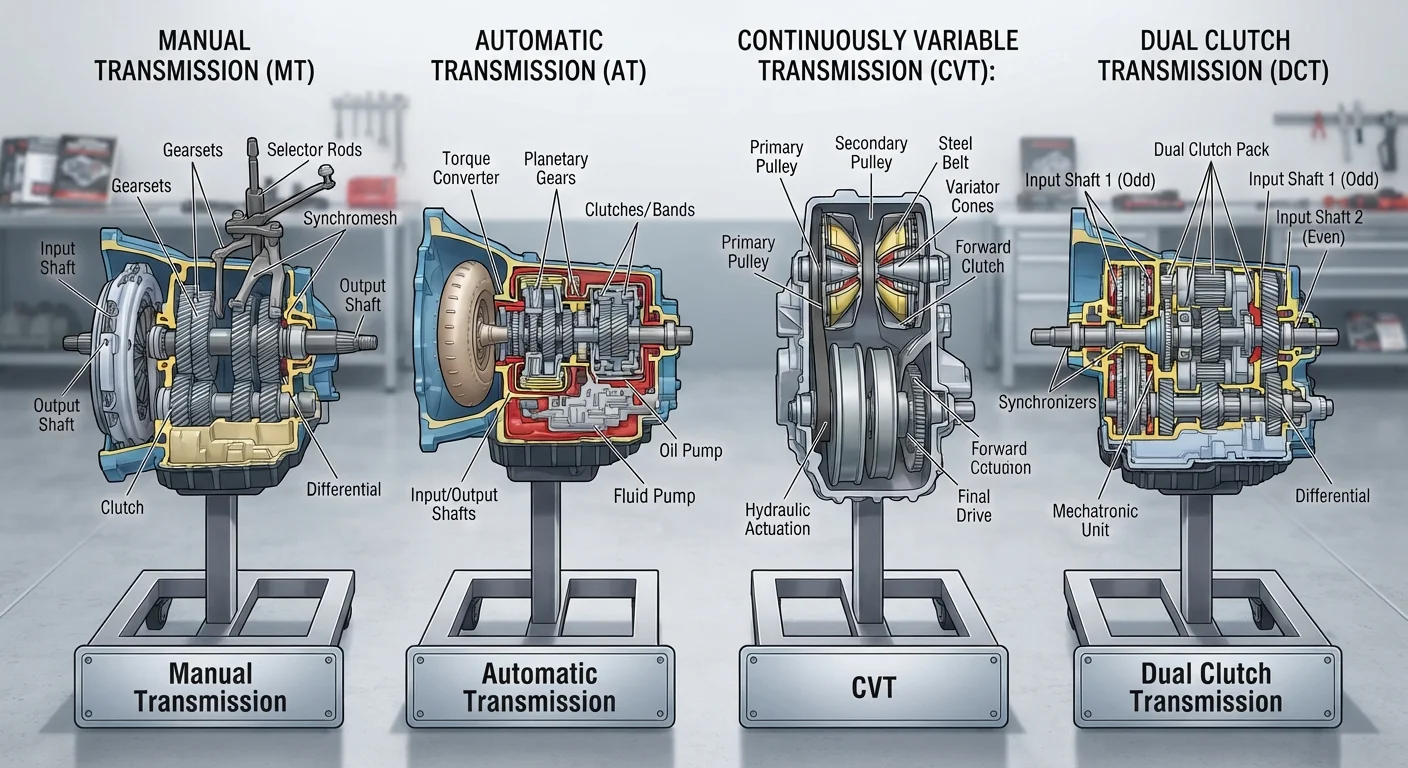
Photo: FaqsDrive.com | Smart Way To Search editorial
—— In This Article
Key Takeaways
- Manual transmissions give the driver direct control but require a learning curve and active engagement.
- Automatic transmissions are the most common in the U.S., offering seamless, hands-free gear changes.
- CVTs use a belt-and-pulley system to deliver smooth, stepless acceleration and often better fuel economy.
- Dual-clutch transmissions combine automatic convenience with near-manual speed for performance-oriented driving.
- Each type has distinct maintenance needs - transmission fluid care applies to all four.
How Each Transmission Type Works
Your transmission's job is to transfer power from the engine to the wheels at the right speed and torque for any driving condition. Understanding how each type does that - in plain terms - helps you know what you're buying and what to expect day to day. For a broader look at the systems working alongside your transmission, see our plain-English map of what's under your hood.
Manual
A manual transmission (also called a stick shift or standard) uses a driver-operated clutch pedal to disconnect the engine from the gearbox momentarily, allowing you to select a gear by hand. Power flow is direct and mechanical, which many drivers describe as a connected, responsive feel.
Automatic
A traditional automatic uses a hydraulic torque converter instead of a clutch, automatically selecting from a fixed set of gears (commonly 6-10 in modern vehicles) based on speed and throttle input. The driver simply selects Drive and goes.
CVT
A continuously variable transmission (CVT) replaces fixed gears entirely with a belt or chain running between two variable-diameter pulleys. This lets the engine stay at its optimal RPM regardless of vehicle speed, producing a smooth, step-free acceleration that some drivers find unusual at first.
Dual-Clutch (DCT)
A dual-clutch transmission (DCT) uses two separate clutch packs - one for odd gears, one for even. While one gear is engaged, the next is already pre-selected on the other clutch, enabling extremely fast, seamless shifts. DCTs can operate in full automatic mode or with manual paddle-shift control.
Head-to-Head Comparison
The table below breaks down how these four transmission types stack up across criteria that matter most to everyday drivers.
| Criterion | Manual / Automatic | CVT / Dual-Clutch |
|---|---|---|
| Gear Selection | Manual: driver-controlled; Auto: automatic fixed gears | CVT: stepless/infinite ratios; DCT: pre-selected automatic |
| Fuel Economy Potential | Manual: moderate-good; Auto: moderate | CVT: often highest; DCT: good-very good |
| Shift Speed | Manual: driver-dependent; Auto: smooth but slower | CVT: seamless; DCT: extremely fast |
| Driver Engagement | Manual: very high; Auto: low | CVT: low; DCT: moderate-high with paddles |
| Learning Curve | Manual: significant; Auto: minimal | CVT: minimal; DCT: minimal (auto mode) |
| Repair Familiarity | Manual: very common; Auto: very common | CVT: growing; DCT: more specialized |
| Typical Availability | Manual: declining in U.S.; Auto: most common | CVT: widespread economy cars; DCT: performance/some mainstream |
Fuel economy figures vary significantly by vehicle model, engine size, and driving habits - use EPA estimates as a general guide, not a guarantee.
Driver Feel, Reliability, and Maintenance
Beyond the specs, how a transmission feels to drive and how it holds up over time are equally important considerations.
~96%
U.S. new car sales with automatic-style transmissions
Estimates from automotive industry analysts indicate that the vast majority of new vehicles sold in the U.S. use automatic, CVT, or dual-clutch transmissions rather than traditional manuals.
60K-100K mi
Typical manual clutch replacement interval
Clutch lifespan varies widely based on driving habits - frequent aggressive or improper use can reduce it significantly.
30,000 mi
Common transmission fluid change interval (varies by type)
Many manufacturers recommend transmission fluid inspection or changes between 30,000 and 60,000 miles, though CVT fluid intervals often differ - always consult your owner's manual.
Driver Experience
Manual drivers report a high degree of control and engagement, but stalling in traffic or on hills is a real learning challenge for beginners. Automatics are universally accessible. CVTs produce a characteristic "rubber-band" sensation during hard acceleration - engine revs climb before speed catches up - which takes some getting used to. DCTs are praised for their crisp, rapid shifts but can feel jerky in slow, stop-and-go traffic, particularly in earlier designs.
Long-Term Reliability
Manuals have relatively simple mechanical designs and a long history of reliability when the clutch is not slipped excessively. Traditional automatics are extremely well-understood by mechanics nationwide. CVT durability varies by manufacturer and has improved in recent generations, but some earlier CVTs had noted reliability concerns - always research a specific vehicle's history. DCTs are generally reliable in higher-end applications but have shown sensitivity to low-speed, high-heat conditions in some earlier mass-market deployments.
Maintenance
All four types require periodic transmission fluid service - neglecting this is one of the most common causes of premature transmission wear. Manual transmissions also need clutch replacement over time, typically between 60,000 and 100,000 miles depending on driving style. For guidance on checking and topping off your transmission fluid at home, see our practical fluid-checking walkthrough. Transmission fluid is also covered in the broader car maintenance hub.
Which Transmission Fits Your Life?
No single transmission type is universally superior - the right choice depends on how and where you drive.
- City commuters in heavy stop-and-go traffic often find automatics or CVTs the least fatiguing option.
- Highway-heavy drivers may appreciate the fuel economy gains a CVT can offer on longer, steady-speed trips.
- Driving enthusiasts or those who want full control tend to prefer manuals or DCTs.
- New or infrequent drivers are generally best served starting with an automatic, which removes the coordination demand of clutch and gear management.
It's also worth noting how your transmission interacts with your vehicle's drivetrain layout. Whether your car is front-wheel drive, all-wheel drive, or rear-wheel drive affects which transmission options are available to you - our guide to drivetrain types explains how these systems connect.
When to Consult a Mechanic
Transmission repairs are among the most expensive in automotive maintenance. If you notice slipping gears, delayed engagement, unusual noises, or a burning smell, have a qualified mechanic inspect your vehicle promptly. Early diagnosis almost always reduces repair costs. Do not attempt internal transmission repairs without professional training and equipment.
Whatever transmission your vehicle has, keeping up with scheduled fluid changes is the single most impactful maintenance habit you can build for long-term reliability.

Automotive Basics Editorial Team
Automotive Basics Editorial Team is the collective byline for our editorial team and contributor network. Articles published under this byline or an editorial pen name are researched, written, and reviewed according to our editorial standards for clarity, consistency, and independence before publication.
View author profile