
Envelope Budgeting vs. Digital Spending Trackers: Which Approach Fits Your Life?
Cash envelope budgeting and digital tracking apps take very different approaches to spending control. Here's how to weigh them for your habits.
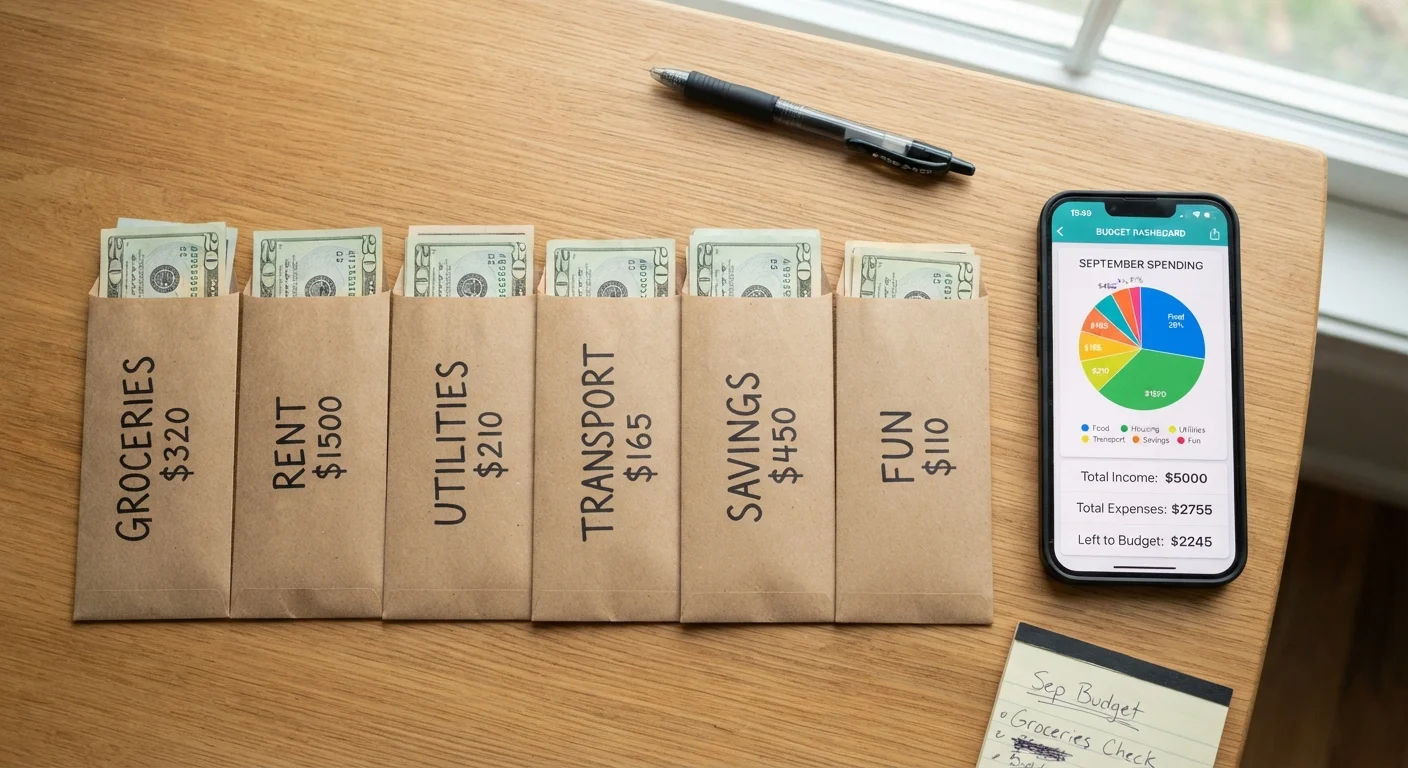
Photo: FaqsDrive.com | Smart Way To Search editorial
—— In This Article
Key Takeaways
- Envelope budgeting uses physical cash to enforce spending limits by category.
- Digital trackers automate transaction logging but require consistent review to be effective.
- Envelope budgeting works best for impulsive spenders; digital tools suit analytical planners.
- Both methods require an upfront decision about how much to allocate per category.
- A hybrid approach — digital tracking plus virtual envelopes — works well for cashless households.
How Each Method Actually Works
Envelope budgeting is one of the oldest personal finance systems around. At the start of each pay period, you withdraw cash and divide it into labeled envelopes — one for groceries, one for gas, one for entertainment, and so on. When an envelope is empty, that category is done for the month. There's no workaround, no minimum payment, and no end-of-month surprise. It's a system built around physical reality.
Digital spending trackers operate on a completely different premise. Instead of pre-loading cash, you connect the tool to your checking accounts and credit cards. Every time you swipe or tap, the transaction is imported automatically and sorted into a spending category. Some tools use algorithms to categorize purchases; others let you assign categories manually. The payoff is a real-time view of where your money has gone — and how much room you have left.
For a broader look at how these and other systems fit together, see this introduction to budgeting.
| Criterion | Envelope Budgeting | Digital Spending Trackers |
|---|---|---|
| Spending medium | Cash only | Cards, accounts, transfers |
| Setup effort | Low — withdraw and label cash | Medium — connect accounts, configure categories |
| Ongoing effort | Daily cash handling | Periodic review of imported data |
| Spending limit enforcement | Automatic — cash runs out | Manual — you must act on alerts |
| Online purchases | Awkward to integrate | Tracked seamlessly |
| Privacy / data sharing | No data shared | Bank credentials shared with app |
| Historical trend analysis | Limited without manual logging | Strong — months of data at a glance |
| Cost | Free (envelopes only) | Free to paid subscription tiers |
The Real Strengths and Weaknesses of Each
Envelope budgeting's greatest strength is friction. Paying with cash makes spending feel more concrete — research in behavioral economics consistently shows people spend less when handling physical money versus tapping a card. The system also requires no technology, no ongoing subscription, and no sharing of financial data with a third party. Its weaknesses are equally real: carrying cash is inconvenient, online purchases don't fit the model, and if an envelope is lost or stolen, that money is simply gone.
Digital trackers shine when your financial life is complex — multiple accounts, recurring subscriptions, and very few cash transactions. They remove the tedium of manual logging and surface patterns you'd never spot on your own. The downside is that automation can create a false sense of control. Reviewing a colorful pie chart is not the same as acting on what it shows. Many people set up a tracking app, glance at it once, and never change their behavior.
~1 in 3
Americans who follow a formal budget
A Gallup survey found roughly one-third of U.S. adults maintain a detailed household budget, suggesting most people track spending informally or not at all.
18%
Less spent when paying with cash vs. card
Consumer behavior studies have found that people consistently spend less when using physical cash, due to the psychological 'pain of paying' that card transactions reduce.
If you're weighing other structured frameworks alongside these tools, the 50/30/20 Rule, zero-based budgeting, and envelope method comparison breaks down how each pairs with different personalities and income types.
Choosing the Right Fit — or Combining Both
The honest answer is that neither method is universally superior. Your choice should reflect how you actually spend money today, not how you wish you did. Ask yourself: Do I use cash regularly? Am I motivated by visual data or by physical limits? Do I have the discipline to review reports and adjust, or do I need the system to enforce limits automatically?
For people who do most spending on cards, a hybrid approach is worth considering: use a digital tracker for visibility, but set up virtual envelopes (sub-accounts or budget category limits within the app) to replicate the hard-stop discipline of the cash system. Some apps are built around this exact concept, mimicking envelope logic without requiring physical cash.
Whatever you choose, the method only works if you review it regularly. An end-of-month check-in — examining what you actually spent versus what you planned — is what turns either system from a passive record into an active tool. See how to run a monthly budget health check for a practical walkthrough. For a side-by-side look at the broader trade-offs between manual and digital tracking, tracking by hand vs. using an app covers the full picture.
The Hybrid Middle Ground
If your household is nearly cashless but you want the discipline of envelope logic, several budgeting apps allow you to create virtual spending envelopes tied to actual card transactions. These combine the visibility of digital tracking with the hard-limit structure of cash envelopes. It's worth exploring this option before assuming you must choose one approach or the other.
This article is for general informational and educational purposes only and does not constitute personalized financial advice. Consult a qualified financial professional for guidance tailored to your specific circumstances.

Smart Shopping Editorial Team
Smart Shopping Editorial Team is the collective byline for our editorial team and contributor network. Articles published under this byline or an editorial pen name are researched, written, and reviewed according to our editorial standards for clarity, consistency, and independence before publication.
View author profile