
Small Kitchen, Big Function: Organizing Cabinets, Drawers, and Countertops
Limited kitchen space doesn't have to mean constant chaos. Practical strategies for organizing even the smallest kitchen efficiently.
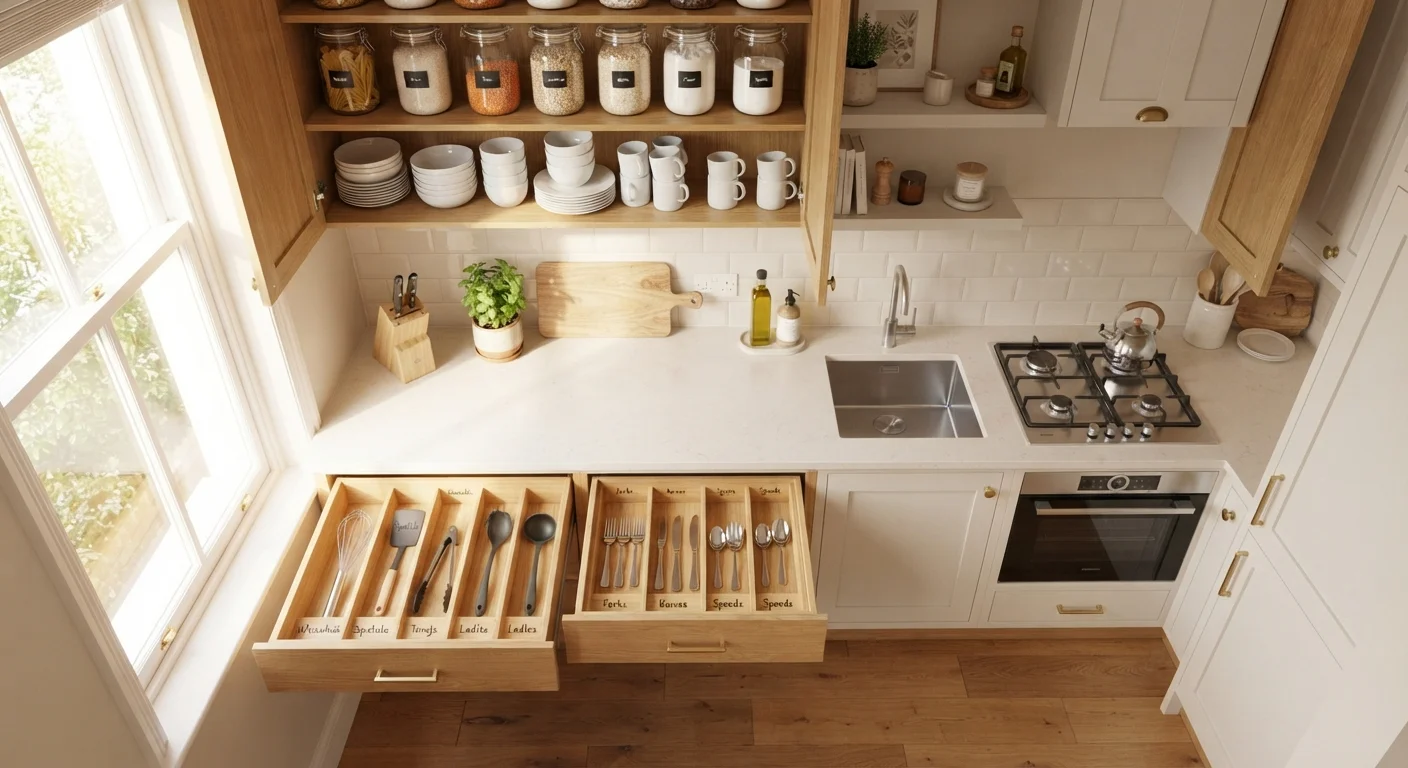
Photo: FaqsDrive.com | Smart Way To Search editorial
—— In This Article
Key Takeaways
- Decluttering before organizing prevents rearranging clutter you don't need.
- Grouping items by how you use them — not by category — saves time and frustration daily.
- Vertical space inside cabinets is often underused and easy to reclaim with simple inserts.
- Keeping countertops to three or fewer everyday items dramatically reduces visual chaos.
- Drawer dividers turn chaotic utensil storage into a system that maintains itself.
Why Small Kitchens Feel More Chaotic Than They Need To
A small kitchen isn't the problem — disorganized storage is. When cabinets are overstuffed, countertops catch every stray item, and drawers become a jumble of mismatched tools, the kitchen feels smaller and harder to use than it actually is. The good news: a few targeted changes can reclaim meaningful space without a renovation.
If you're starting from a place of general household clutter, it helps to read our beginner's guide to decluttering first. For the kitchen specifically, the steps below build a system that works with how you actually cook — not an idealized version of it.
What you will need
What You'll Need Before You Start
You don't need expensive containers or a full weekend to organize a small kitchen. Most of what helps is inexpensive, widely available, and quick to implement. Gather what you can before starting so you're not stopping mid-process.
Shelf risers or stackable cabinet organizers
Double the usable vertical space inside upper and lower cabinets.
Drawer dividers
Separate utensils, tools, and small items so drawers stay sorted without effort.
Clear bins or small baskets
Group similar pantry or cabinet items so you can pull out an entire category at once.
Over-the-door or inside-cabinet-door organizers
Use otherwise wasted door surface area for spices, foil, wraps, or cleaning supplies.
Labels or a label maker
Identify bin and shelf contents so the system is easy for everyone in the household to follow.
Lazy Susan (turntable tray)
Improve access to items stored in deep corners of lower cabinets.
For ideas on comparing storage options for other rooms as well, see our overview of fixed vs. modular storage systems.
Step-by-Step: Organizing Your Kitchen
Work through these steps in order. Each one builds on the last, so skipping ahead — especially past the declutter step — often means redoing work later.
Empty and Declutter One Zone at a Time
Start with a single cabinet or drawer — not the entire kitchen. Empty it completely, then sort everything into three groups: keep, donate or discard, and relocate (items that belong elsewhere in the home). Only return items you actively use in the kitchen.
Be honest about duplicates and single-use gadgets. If you have four wooden spoons and use one, keep two at most. The goal is to store only what earns its place.
Group Items by How You Use Them
Rather than organizing by item type (all baking together, all spices together), organize by cooking task. Keep everything needed to make coffee in one spot. Put the cutting board, knives, and prep bowls near the counter where you chop. Store pots and pans near the stove.
This "activity zone" approach means you reach for fewer things across the kitchen when cooking, which also makes cleanup faster.
Maximize Vertical Space Inside Cabinets
Most cabinet shelves are spaced for tall items even when you're storing short ones, leaving dead air above. Shelf risers and stackable organizers split that unused height into two usable levels. Use them for plates, bowls, canned goods, or pantry staples.
For more ways to use vertical and corner space throughout your home, a dedicated overview covers the broader approach.
Divide and Conquer Your Drawers
An undivided kitchen drawer quickly becomes a catch-all. Drawer dividers — even simple ones — give every category of item its own lane: cooking utensils, measuring tools, can opener, etc. Once divided, the drawer sorts itself because there's only one logical place each thing can go.
For a junk drawer that's accumulated miscellaneous items, sort first. Toss anything broken or duplicated, relocate anything that belongs in another room, then divide what remains.
Ruthlessly Edit Your Countertops
Countertops are prime real estate in a small kitchen. A general rule: if you don't use an appliance or tool at least three times a week, it doesn't belong on the counter. Move it to a cabinet and see if you miss it. Most people find they don't.
Aim for three or fewer items on the counter: perhaps a coffee maker, a knife block, and a small dish for daily essentials. Everything else should live somewhere with a door on it.
Use Door and Wall Space
The inside faces of cabinet doors and the wall space above or beside the stove are often completely unused. Inside-door organizers hold spice jars, foil and wrap boxes, or cleaning supplies. A magnetic knife strip on the wall frees up an entire drawer or counter block.
Even a small hooks rail near the stove can hold frequently used utensils, reducing the need to open any drawer at all during cooking.
The Three-Times-a-Week Rule
Before deciding where to store something in a small kitchen, ask how often you use it. Items used three or more times a week deserve prime, easy-access spots. Everything else should be stored out of the way — in high cabinets, deep shelves, or another room entirely. This single filter prevents the most common cause of small-kitchen clutter: convenient storage given to rarely used things.
Living with others? Organizing a shared kitchen adds a layer of coordination. Our guide on organizing shared spaces covers how to build systems everyone can maintain.
Maintaining the System Over Time
An organized kitchen only stays that way if the system is easy enough to follow on a busy Tuesday morning. The goal isn't perfection — it's reducing the number of decisions you have to make when you're tired or rushed.
Do a quick five-minute reset at the end of each day: return misplaced items, wipe down countertops, and close cabinet doors. Monthly, scan for things that have crept back in — expired pantry items, duplicate tools, gadgets you've stopped using. Small kitchens have little tolerance for accumulation, so regular light editing is more effective than occasional deep overhauls.
Avoid Reorganizing Without Decluttering First
One of the most common mistakes is buying storage containers before removing items you don't need. Containers added to an overcrowded kitchen often just rearrange the problem without solving it. Always declutter first — then assess what storage you actually need for what remains.
For a broader look at how kitchen organization fits into your whole home, the complete home organization guide is a useful next step. And if you're not sure which storage myths might be holding you back, common organization myths is worth a read.

Home & Garden Editorial Team
Home & Garden Editorial Team is the collective byline for our editorial team and contributor network. Articles published under this byline or an editorial pen name are researched, written, and reviewed according to our editorial standards for clarity, consistency, and independence before publication.
View author profile