
The Anatomy of a Home Electrical Panel for New Homeowners
Breakers, bus bars, and neutral wires — learn what's inside your electrical panel so you know when to DIY and when to call a licensed electrician.
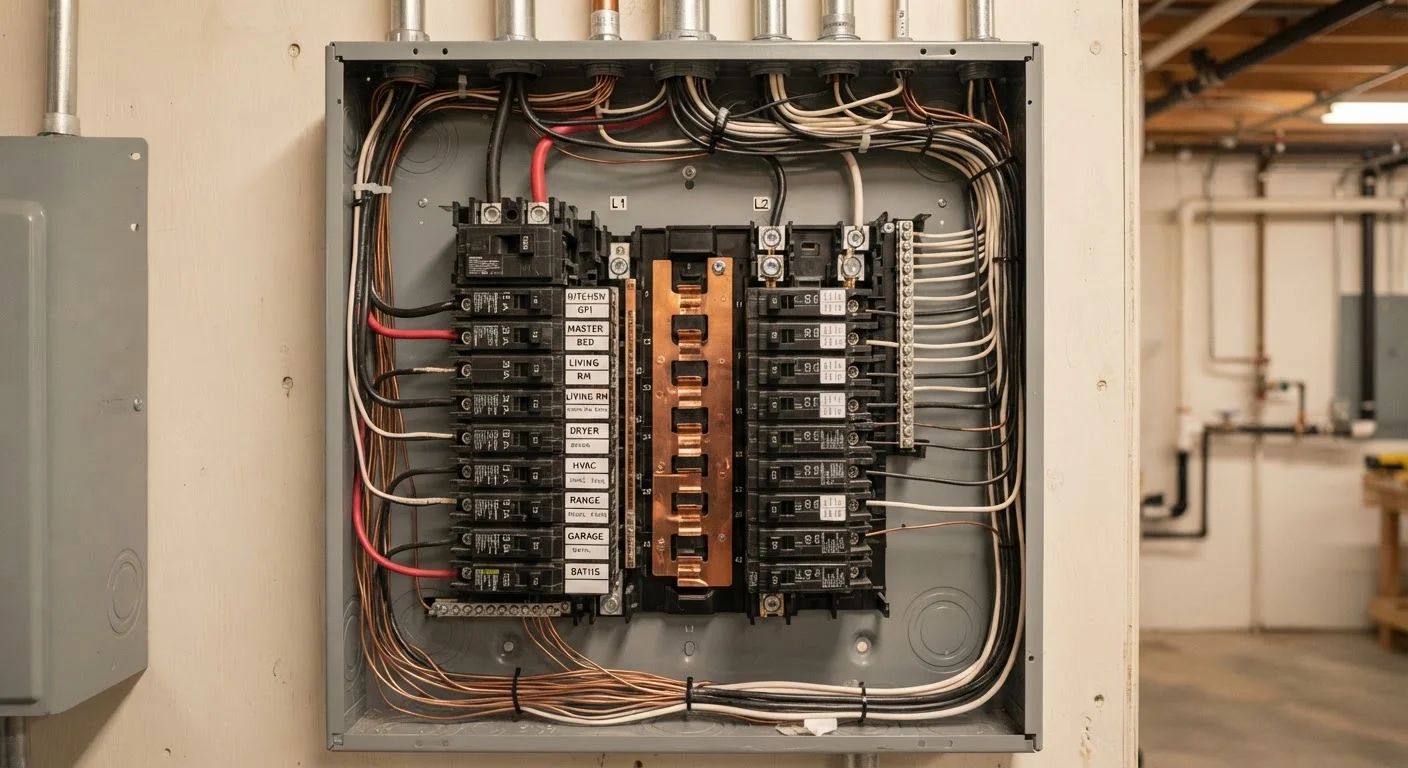
Photo: FaqsDrive.com | Smart Way To Search editorial
—— In This Article
Key Takeaways
- Your electrical panel distributes power from the utility into every circuit in your home.
- Circuit breakers protect each circuit by automatically shutting off when a fault occurs.
- The main breaker controls all power to the panel — flip it off before touching anything inside.
- Labeling breakers accurately is a safe, beginner-friendly task that improves household safety.
- Work involving the main breaker, service entrance wires, or new circuits requires a licensed electrician.
What Is an Electrical Panel and What Does It Do?
Your electrical panel — also called a breaker box, load center, or service panel — is the hub where electricity from the utility company enters your home and gets divided into smaller circuits. Think of it as a central traffic controller: utility power arrives on two thick service wires, and the panel routes that power through individual breakers to every room, appliance, and outlet in your house.
Panels are rated by amperage, typically 100, 150, or 200 amps for residential homes. A 200-amp panel can supply more simultaneous load than a 100-amp panel, which matters if you have electric appliances, EV charging, or a large home. Knowing your panel's rating tells you a lot about your home's electrical capacity before you add major appliances or plan a renovation. For a broader view of systems that work quietly behind your walls, our home insulation overview offers a similar plain-language tour of another critical but invisible home system.
The Key Components Inside Your Panel
Opening the panel door (not the inner cover) reveals a structured layout of components, each with a specific job.
- Main breaker: The large double-pole breaker at the top controls all power flowing into the panel. Flipping it off cuts power to every branch circuit but does not de-energize the service entrance wires above it — those remain live at all times.
- Hot bus bars: Two vertical metal rails run down the center of the panel. Each carries 120 volts. Branch circuit breakers clip onto these bars to draw power.
- Neutral bus bar: A separate terminal bar where white (neutral) wires connect. It provides the return path for current and is bonded to ground at the main panel.
- Ground bus bar: Connects bare copper or green ground wires to the panel's metal enclosure and, ultimately, to a grounding electrode (usually a metal rod driven into the earth).
- Branch circuit breakers: Individual breakers that protect each circuit in your home — lighting, outlets, appliances. Each is rated in amps (commonly 15 or 20 amps for general circuits).
How Circuit Breakers Work and Why They Trip
A circuit breaker is an automatic switch that opens (trips) when it detects too much current flowing through it. There are two main causes for a trip:
- Overload: Too many devices running on one circuit draw more amps than the breaker is rated for. The breaker heats up internally, and a bimetallic strip bends until it releases the switch. This protects the wiring from overheating and potentially starting a fire.
- Short circuit: A hot wire and a neutral or ground wire make unintended contact, causing a sudden surge of current. The breaker trips almost instantly.
A tripped breaker sits in the middle position between ON and OFF. To reset it, push it fully to OFF, then firmly back to ON. If it trips again right away, do not keep resetting it — an underlying fault needs diagnosis. Just as with vehicle maintenance, knowing the difference between a task you can handle and one that requires a professional is the key to staying safe. Our article on DIY car maintenance safety explores that same principle in an automotive context.
Never Ignore a Repeatedly Tripping Breaker
A breaker that trips again and again is signaling a real problem — an overloaded circuit, damaged wiring, or a failing appliance. Repeatedly resetting it without investigating the cause can allow wiring to overheat and create a fire hazard inside your walls. Have a licensed electrician diagnose the root cause before restoring that circuit to normal use.
What You Can Safely Do Yourself
Several panel-related tasks are low-risk and beginner-friendly when approached carefully:
- Labeling circuits: Use the panel's directory card to map each breaker to its room or load. Plug a lamp into an outlet, then flip breakers one at a time until the lamp goes off. Accurate labels speed up every future repair and help emergency responders.
- Resetting tripped breakers: As described above, a single reset is fine. Repeated tripping means call a pro.
- Covering open slots: Blank breaker fillers snap into empty spaces and keep fingers and debris away from live bus bars.
- Visual inspection of the door area: Look for scorch marks, melted plastic, or a burning smell. These are warning signs worth reporting to an electrician promptly.
Building confidence with safe, foundational tasks is a great starting point. If you're ready to tackle a broader home project, our guide on completing your first weekend home improvement project walks you through planning and executing manageable DIY work. Having the right hand tools on hand will also make these tasks easier.
Label Your Breakers Now — Not Later
Take 20 minutes to map every breaker using a lamp or phone charger as a test device. Write clear, specific labels (e.g., 'Master bedroom outlets' rather than just 'Bedroom') directly on the directory card inside the panel door. Accurate labels save time during every future repair and help anyone — including emergency responders — shut off the right circuit quickly.
When to Call a Licensed Electrician
Electrical work can be fatal if done incorrectly. The following tasks should always be performed by a licensed electrician:
- Replacing or upgrading the main breaker or the entire panel
- Adding new branch circuits or sub-panels
- Any work near the service entrance wires (the two thick wires entering the top of the panel — these are never de-energized by the main breaker)
- Installing AFCI (arc-fault circuit interrupter) or GFCI (ground-fault circuit interrupter) breakers if you are unfamiliar with the wiring inside
- Investigating repeated tripping, burning smells, or discoloration inside the panel
Many electrical projects also require a permit and inspection under local building codes. Your electrician will typically handle the permit process, but it's worth asking about it upfront. Requirements vary by municipality, so always verify with your local building department before starting any electrical work beyond basic tasks.
This article is for general informational purposes only. Electrical work carries serious safety and legal risks. Always consult a licensed, qualified electrician before performing any work beyond the basic maintenance tasks described here, and verify permit requirements with your local authority.
Frequently Asked Questions

Home & Garden Editorial Team
Home & Garden Editorial Team is the collective byline for our editorial team and contributor network. Articles published under this byline or an editorial pen name are researched, written, and reviewed according to our editorial standards for clarity, consistency, and independence before publication.
View author profile