
Lifetime Cost vs. Purchase Price: The Real Math Behind a Buying Decision
A cheaper product can cost more over time. Learn how to calculate total cost of ownership before committing to any purchase.
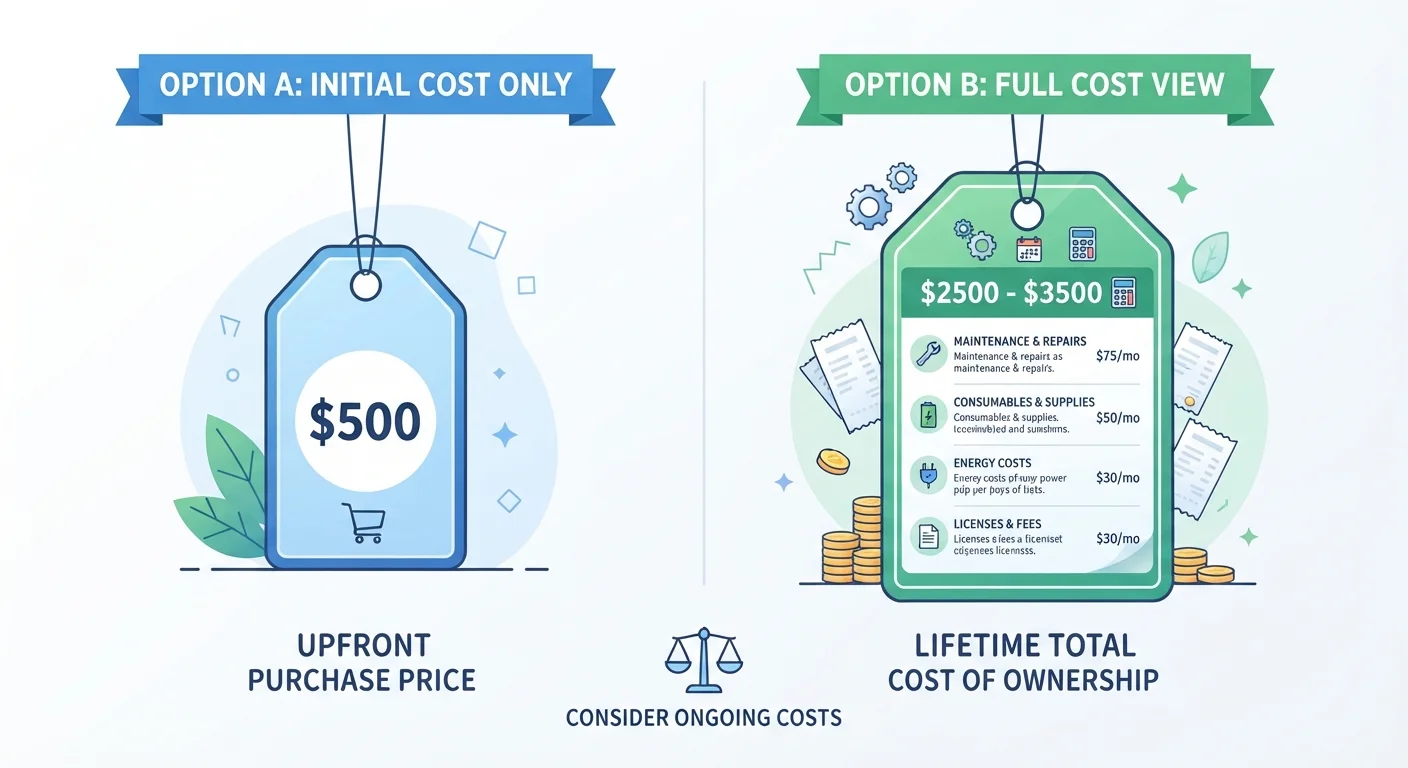
Photo: FaqsDrive.com | Smart Way To Search editorial
—— In This Article
Key Takeaways
- The purchase price is only one part of what a product actually costs you.
- Ongoing expenses like energy use, supplies, and repairs often outweigh the initial price difference.
- Calculating total cost of ownership before buying leads to smarter, more honest comparisons.
- A higher upfront cost can mean lower lifetime cost — and vice versa.
- Asking the right questions before any major purchase protects your budget long-term.
Why the Sticker Price Is the Wrong Starting Point
Walk into any store and you're presented with prices designed to look simple. One number. One decision. But that number rarely tells the whole story of what something will actually cost you.
The purchase price — sometimes called the sticker price — only covers the moment of acquisition. Everything that happens after you leave the store is its own financial chapter: the electricity a refrigerator draws for a decade, the ink cartridges a printer demands every few months, the filters an HVAC system needs each season. These are real costs, and they compound quietly over time.
For everyday shoppers, this matters because the math often flips the obvious choice. The cheaper option at the register can easily become the more expensive option over a realistic ownership period. Understanding this is the foundation of smarter buying decisions — and it's exactly what smart budgeting is built on.
2–4×
Lifetime cost vs. purchase price for major appliances
Consumer energy and appliance research consistently shows that operating costs over a 10–15 year lifespan often exceed the original purchase price of major home appliances.
$1,500+
Average annual vehicle operating cost beyond loan payments
The American Automobile Association (AAA) regularly estimates that fuel, maintenance, tires, and insurance add thousands of dollars annually to vehicle ownership beyond the purchase or financing cost.
30–50%
Energy cost variation between similar appliance models
The U.S. Department of Energy notes that energy efficiency differences between comparable appliances can result in meaningful cost differences over a product's lifetime.
Breaking Down Total Cost of Ownership
Total Cost of Ownership (TCO) is a straightforward concept once you know what to look for. It has a few consistent components:
- Purchase price: What you pay upfront, including taxes and delivery.
- Operating costs: Ongoing energy use, water, or fuel consumption.
- Consumables: Ink, filters, blades, batteries — anything that gets used up and replaced.
- Maintenance and repairs: Scheduled service, parts replacement, and unexpected fixes.
- Opportunity cost of reliability: Time and inconvenience when something breaks down frequently.
- End-of-life costs: Disposal fees, recycling costs, or the reduced resale value of a worn-out item.
To estimate TCO, add your purchase price to the sum of annual ongoing costs multiplied by expected years of use. Even a rough estimate — done before you buy — gives you a much clearer picture than the sticker price alone. See our questions worth asking before any major purchase for a practical framework to gather this information.
“Price is what you pay. Value is what you get. They are not always the same thing — and the gap between them becomes clearest when you account for everything ownership actually requires.”
— Warren Buffett, Investor and author of numerous shareholder letters on the distinction between price and value
Real-World Examples That Change the Math
The difference between sticker price and lifetime cost becomes clearest when you look at concrete situations.
The same logic applies beyond appliances. When comparing travel options, for instance, the cheaper ticket isn't always the cheaper trip once you account for baggage fees, ground transportation, and time. Our piece on flying vs. driving costs walks through exactly this kind of full-cost comparison.
Similarly, skipping routine upkeep to save money in the short term is one of the most common ways people accidentally inflate their lifetime costs. Our article on the real cost of skipping routine maintenance illustrates how deferred maintenance leads to much larger bills down the road.
How to Apply This Before Your Next Purchase
You don't need a spreadsheet for every purchase — but for anything significant, a few deliberate questions change the outcome.
Quick TCO Estimate: A Simple Formula
Take the purchase price and add (annual operating cost × expected years of use) plus estimated repair costs. Compare this total across your options — not just the purchase prices. Even a five-minute estimate using manufacturer specs and typical energy rates can meaningfully change which product looks like the better deal.
Start by estimating how long you realistically expect to own or use the product. Then identify the main cost categories that apply: energy, consumables, service. Even rough estimates — pulled from product specs, consumer reviews, or manufacturer documentation — are far more useful than ignoring these costs entirely.
It's also worth comparing unit pricing when evaluating similar products. Our explainer on price per unit vs. sticker price covers how to use that number as a sharper lens for value comparisons.
Finally, keep in mind that inflation affects operating costs over time — energy prices and parts costs rarely stay flat. For a deeper look at how that works, see our article on how inflation erodes purchasing power.
The goal isn't to overthink every purchase. It's to know which purchases deserve a closer look — and to approach those with the full picture rather than just the price on the tag.
Frequently Asked Questions

Smart Shopping Editorial Team
Smart Shopping Editorial Team is the collective byline for our editorial team and contributor network. Articles published under this byline or an editorial pen name are researched, written, and reviewed according to our editorial standards for clarity, consistency, and independence before publication.
View author profile