
Why Automating Savings Works—and Where It Can Backfire
Automatic transfers remove friction from saving, but they can also cause overdrafts or mask cash flow problems. The full trade-off, explained.
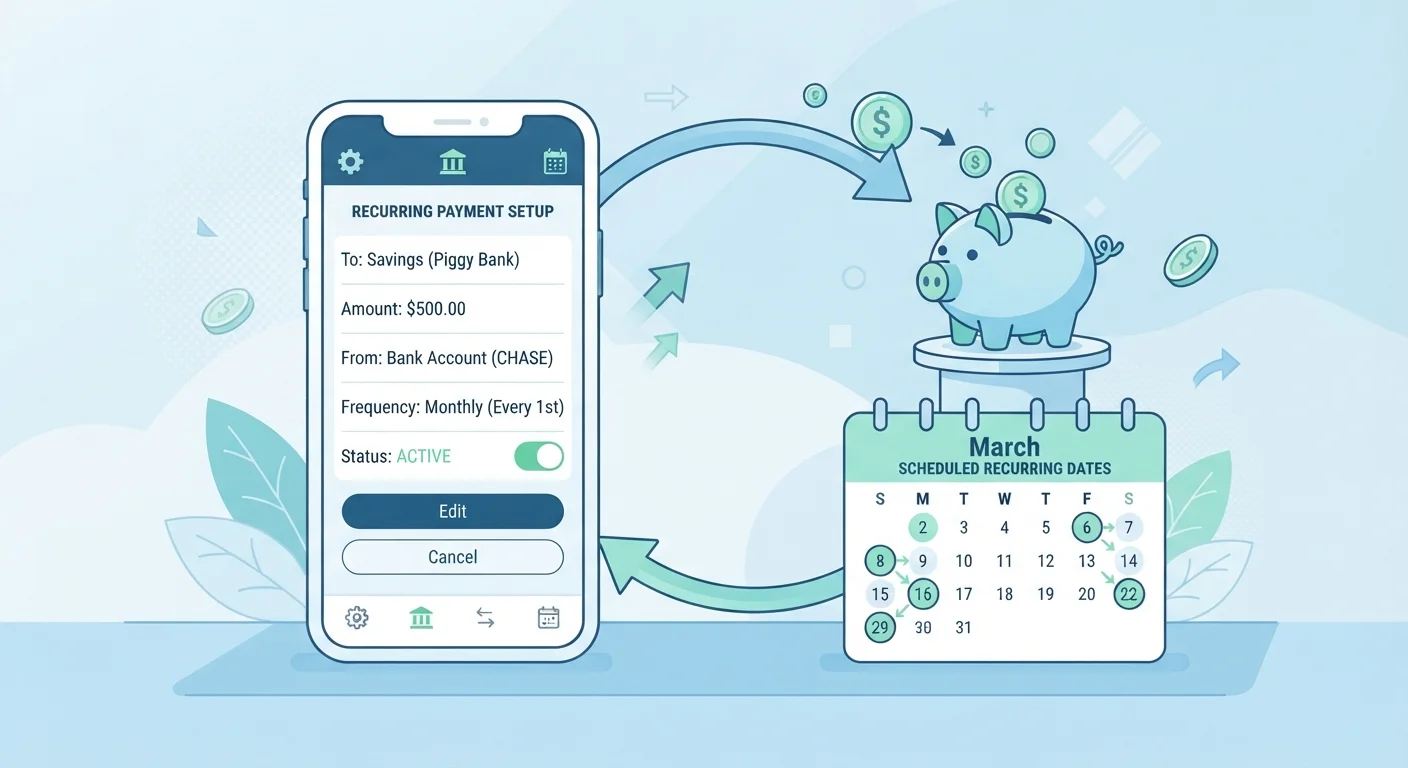
Photo: FaqsDrive.com | Smart Way To Search editorial
—— In This Article
Key Takeaways
- Automated transfers move money to savings before you can spend it, removing friction from the habit.
- Irregular income is the biggest risk factor—fixed transfers can overdraft an account that dips between paychecks.
- Automation can create a false sense of financial health if it runs alongside unaddressed cash flow problems.
- High-interest debt often deserves priority over savings automation, since interest charges may outpace savings growth.
- Aligning transfer timing with paycheck deposits and starting with a conservative amount reduces most common risks.
Removes the decision to save every pay period
When saving is automatic, you never have to choose between saving and spending in the moment. This eliminates one of the most consistent behavioral barriers people face when trying to build savings.
Money moves before spending temptation hits
The transfer happens before you see the full checking balance, making it less likely you'll mentally earmark that money for something else before it leaves.
Small, consistent amounts compound into real balances
Regular deposits—even modest ones—grow steadily over time, particularly when directed to an interest-bearing account. Frequency and consistency matter more than size.
Builds a savings habit without ongoing effort
Repeated automatic transfers normalize saving as part of your financial routine, so it starts to feel like a fixed expense rather than a sacrifice or an afterthought.
Works even when motivation is low
Willpower and financial enthusiasm naturally fluctuate. Automation keeps saving happening regardless of how you feel about your finances on any given payday.
Can trigger overdraft fees with irregular income
A fixed transfer on a set date can hit when your checking balance is low, resulting in overdraft charges that cost more than the amount you were trying to save.
May mask underlying cash flow problems
Watching a savings balance grow can create a false sense of financial security even when monthly expenses are quietly outpacing income in the background.
Can divert money better used for high-interest debt
If credit card or loan interest rates exceed what your savings account earns, consistently putting money into savings first can cost more over time than paying down that debt would.
Settings become outdated without regular review
Life changes—new expenses, reduced income, added debt—but automation doesn't update itself. A once-comfortable transfer amount can quietly become a monthly strain.
Difficult to pause immediately in a cash crunch
Some banks require advance notice or one to two business days to cancel a scheduled transfer, meaning a payment can still process at exactly the moment you need those funds most.
How Automated Savings Actually Works
When you automate savings, you instruct your bank or employer to move a fixed dollar amount into a savings account on a recurring schedule—typically every payday. The transfer happens before you see the full balance sitting in your checking account, which makes you less likely to spend that money first.
This approach is often called paying yourself first: a behavioral strategy built on the observation that most people spend whatever is available and save what remains—which is often nothing. Automation reverses that sequence without requiring a weekly decision or a burst of motivation.
Most banks and credit unions let you set up recurring transfers through their mobile app or website in just a few minutes. Some employers also allow you to split a direct deposit, routing part of each paycheck straight to savings. The mechanics are simple; the discipline is built in. For a broader look at why saving is difficult even with the best intentions, see what research says about savings gaps.
~37%
U.S. adults who'd struggle to cover a $400 emergency
Federal Reserve surveys on U.S. household finances have found that a substantial share of American adults say they could not cover a $400 unexpected expense without borrowing or selling something.
$15.5B
Overdraft and NSF fees collected by U.S. banks in 2019
The Consumer Financial Protection Bureau (CFPB) reported that U.S. banks collected approximately $15.5 billion in overdraft and non-sufficient funds fees in 2019—underscoring the real cost of low account balances.
Why Automation Genuinely Helps
The core advantage is behavioral, not mathematical. When saving becomes the default—automatic and pre-set—it happens reliably. The habit builds without depending on motivation or memory, which is why this approach tends to work even for people who have struggled to save manually in the past.
Consistent small deposits also add up meaningfully over time, especially when directed to an account that earns interest. The habit of saving regularly, even modestly, typically outperforms sporadic larger deposits that only happen when money feels comfortable. Automation locks in that consistency without requiring you to revisit the decision every pay period.
For people who historically spend what's in their account, moving money out of easy reach before they see it is often more effective than any budget spreadsheet or spending tracker alone.
Removes the decision to save every pay period
When saving is automatic, you never have to choose between saving and spending in the moment. This eliminates one of the most consistent behavioral barriers people face when trying to build savings.
Money moves before spending temptation hits
The transfer happens before you see the full checking balance, making it less likely you'll mentally earmark that money for something else before it leaves.
Small, consistent amounts compound into real balances
Regular deposits—even modest ones—grow steadily over time, particularly when directed to an interest-bearing account. Frequency and consistency matter more than size.
Builds a savings habit without ongoing effort
Repeated automatic transfers normalize saving as part of your financial routine, so it starts to feel like a fixed expense rather than a sacrifice or an afterthought.
Works even when motivation is low
Willpower and financial enthusiasm naturally fluctuate. Automation keeps saving happening regardless of how you feel about your finances on any given payday.
Where It Can Backfire
The most common problems with automated savings aren't about the strategy itself—they're about mismatch: the transfer amount or timing doesn't match your actual cash flow. Cash flow and savings are related but distinct, and treating them as the same thing is where most automation problems begin.
People with irregular income—freelancers, hourly workers, gig workers—face the sharpest risk. A fixed transfer set during a strong income month can overdraft the account during a slow one, turning a savings strategy into a fee generator. And because automation runs quietly in the background, it can take weeks to notice that a problem has developed.
Can trigger overdraft fees with irregular income
A fixed transfer on a set date can hit when your checking balance is low, resulting in overdraft charges that cost more than the amount you were trying to save.
May mask underlying cash flow problems
Watching a savings balance grow can create a false sense of financial security even when monthly expenses are quietly outpacing income in the background.
Can divert money better used for high-interest debt
If credit card or loan interest rates exceed what your savings account earns, consistently putting money into savings first can cost more over time than paying down that debt would.
Settings become outdated without regular review
Life changes—new expenses, reduced income, added debt—but automation doesn't update itself. A once-comfortable transfer amount can quietly become a monthly strain.
Difficult to pause immediately in a cash crunch
Some banks require advance notice or one to two business days to cancel a scheduled transfer, meaning a payment can still process at exactly the moment you need those funds most.
Setting It Up to Minimize the Risks
A few deliberate adjustments make automation far more stable. Schedule the transfer to land one to two business days after your paycheck typically deposits—never before it. Set the dollar amount conservatively, based on a slower income month rather than an average one. You can always increase it once your financial cushion is stable.
Review your setup every few months. New expenses, income changes, or new debt obligations can make a previously reasonable amount a poor fit. If you carry high-interest debt, it's worth asking whether the interest you're paying outpaces what your savings earns—if it does, directing more money toward that debt first often makes more financial sense. Our guide on debt payoff mistakes covers common errors worth knowing before you lock in a savings routine.
Also think about where the automated transfers land. Moving money to a separate account—especially one that takes a day or two to access—adds a layer of friction that discourages impulse withdrawals. Our overview of high-yield vs. traditional savings accounts covers factors worth weighing when choosing where to send those transfers.
Automation Doesn't Replace a Budget
An automatic transfer is a useful tool, but it works best alongside a clear picture of your monthly income and essential expenses. If your fixed costs—rent, utilities, groceries, minimum debt payments—leave little predictable room, map out your cash flow before deciding how much to automate. Automation built on realistic numbers is far more stable than automation based on what you hope your budget looks like.
This article is for general informational purposes only and does not constitute personalized financial advice. Consult a qualified financial professional for guidance tailored to your specific situation.

Personal Finance Editorial Team
Personal Finance Editorial Team is the collective byline for our editorial team and contributor network. Articles published under this byline or an editorial pen name are researched, written, and reviewed according to our editorial standards for clarity, consistency, and independence before publication.
View author profile