
Cash Flow vs. Savings: Two Concepts That Beginners Often Confuse
Having savings doesn't automatically mean healthy cash flow — and vice versa. Understand how these two concepts differ and why both matter.
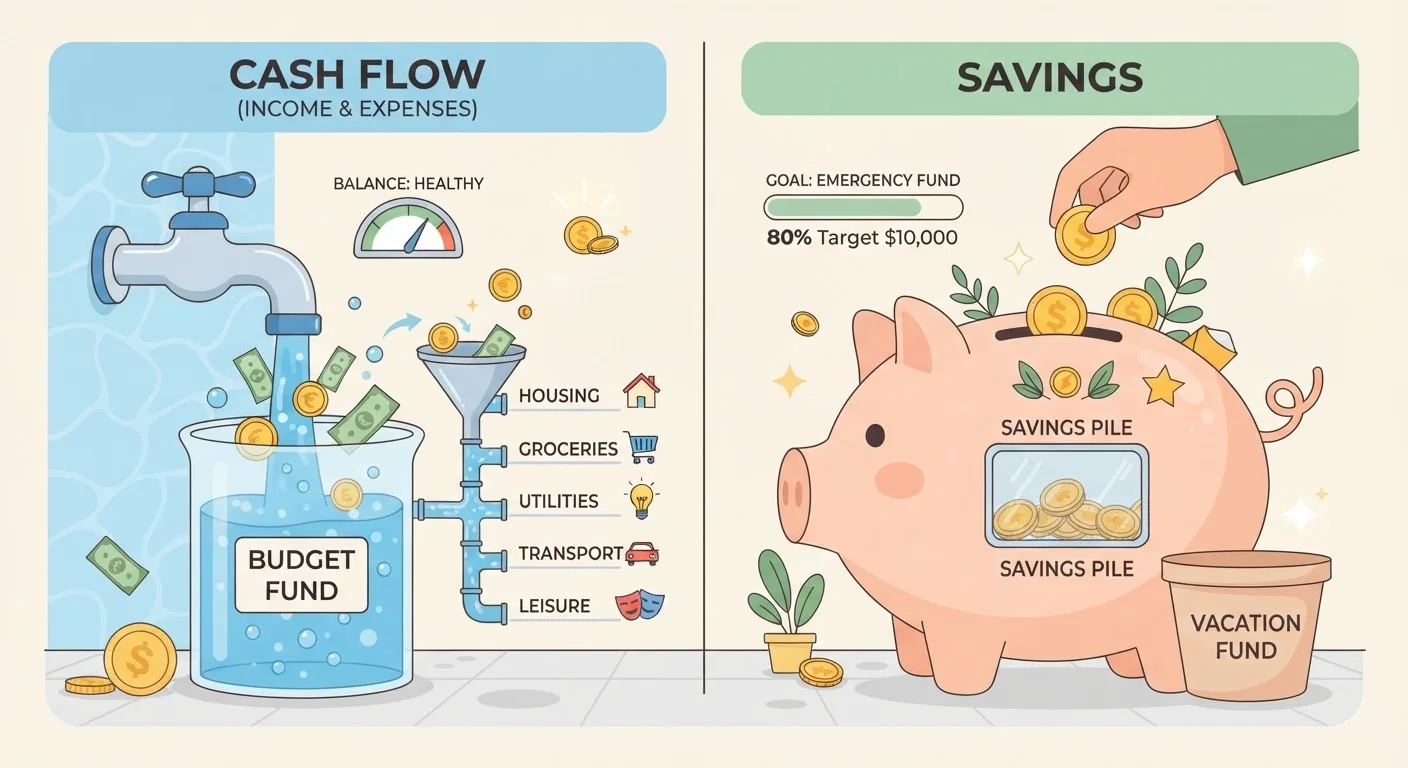
Photo: FaqsDrive.com | Smart Way To Search editorial
—— In This Article
Key Takeaways
- Cash flow measures money moving in and out each month; savings is money you've already set aside.
- You can have substantial savings but still experience negative cash flow if spending exceeds income.
- Positive cash flow is what makes consistent saving possible in the first place.
- Tracking both gives you a more complete and honest picture of your financial health.
- Improving cash flow usually requires either increasing income or reducing regular expenses.
What Each Term Actually Means
These two concepts get tangled up because they're closely related — but they measure different things entirely.
Cash flow is the movement of money in and out of your life over a given period, usually a month. When your income (what comes in) is greater than your expenses (what goes out), you have positive cash flow. When expenses exceed income, that's negative cash flow — and it's a sign of financial strain regardless of what's in your bank account.
Savings, on the other hand, is a balance — a stock of money you've accumulated and set aside rather than spent. It doesn't move unless you add to it or draw from it. Think of it as a reservoir, while cash flow is the stream feeding into or draining from it.
For a deeper look at these and similar terms, the personal finance glossary for beginners covers key budgeting vocabulary in plain language.
| Criterion | Cash Flow | Savings |
|---|---|---|
| What it measures | Money moving in and out monthly | Money accumulated and set aside |
| Type of concept | A rate or flow over time | A balance or stock at a point in time |
| Can be negative | Yes — when expenses exceed income | No — balance can reach zero, not negative |
| Main risk if ignored | Slowly draining any savings you have | No cushion when unexpected costs arise |
| How to improve it | Earn more or spend less each month | Consistently redirect surplus cash |
| Where to track it | Monthly budget or spending tracker | Savings account balance |
Why You Can Have One Without the Other
This is the part that trips people up most. Here are two real-world scenarios that show why cash flow and savings don't always move together:
- Savings without positive cash flow: Imagine someone who received an inheritance or tax refund and has $8,000 sitting in a savings account. But each month, their rent, car payment, and credit card bills add up to more than their take-home pay. They're draining that savings balance slowly — and eventually, it runs out. Healthy savings balance, broken cash flow.
- Positive cash flow without savings: Now picture someone who earns more than they spend every single month — but that surplus just sits in their checking account and gets absorbed by lifestyle spending before the next paycheck arrives. Nothing gets set aside. Good cash flow, no savings to show for it.
Both situations carry risk. The first person faces a countdown to a financial crisis. The second person is vulnerable the moment an unexpected expense appears — a car repair, a medical bill, a missed shift at work.
~57%
Americans unable to cover a $1,000 emergency
A Bankrate survey found that a majority of U.S. adults could not pay an unexpected $1,000 expense from savings alone — illustrating how common the savings gap is even among those with steady incomes.
3–6 months
Recommended emergency fund target
Financial educators broadly suggest keeping three to six months of essential living expenses in an accessible savings account as a baseline financial buffer.
Understanding why accessible money matters is a natural next step once you grasp the difference between these two concepts.
How the Two Concepts Work Together
Cash flow and savings aren't competing priorities — they're sequential. Positive cash flow is what creates the opportunity to save. Without a monthly surplus, there's no raw material to set aside.
Once you have positive cash flow, savings becomes the destination for that surplus. A common starting point is building an emergency fund — typically three to six months of essential expenses stored somewhere accessible. That fund is your savings working as a safety net, bought and paid for by consistent positive cash flow over time.
If your monthly budget is tight, small and consistent contributions still matter. The guide to building a savings habit on a tight budget walks through practical ways to make saving work even when margins are slim.
To get started, try this simple two-step check each month:
- Subtract your total monthly expenses from your take-home income. Positive number? You have a surplus to work with. Negative? That gap needs to close before you can save sustainably.
- Of that surplus, decide what percentage goes directly to savings before it can be spent — even $25 or $50 a month builds the habit.
This article is for general informational and educational purposes only and does not constitute personalized financial advice. Consider consulting a qualified financial professional for guidance specific to your situation.

Personal Finance Editorial Team
Personal Finance Editorial Team is the collective byline for our editorial team and contributor network. Articles published under this byline or an editorial pen name are researched, written, and reviewed according to our editorial standards for clarity, consistency, and independence before publication.
View author profile