
What Your Blind Spots Actually Cover
Understand the real size of your vehicle's blind zones and how to adjust mirrors and awareness to account for them.
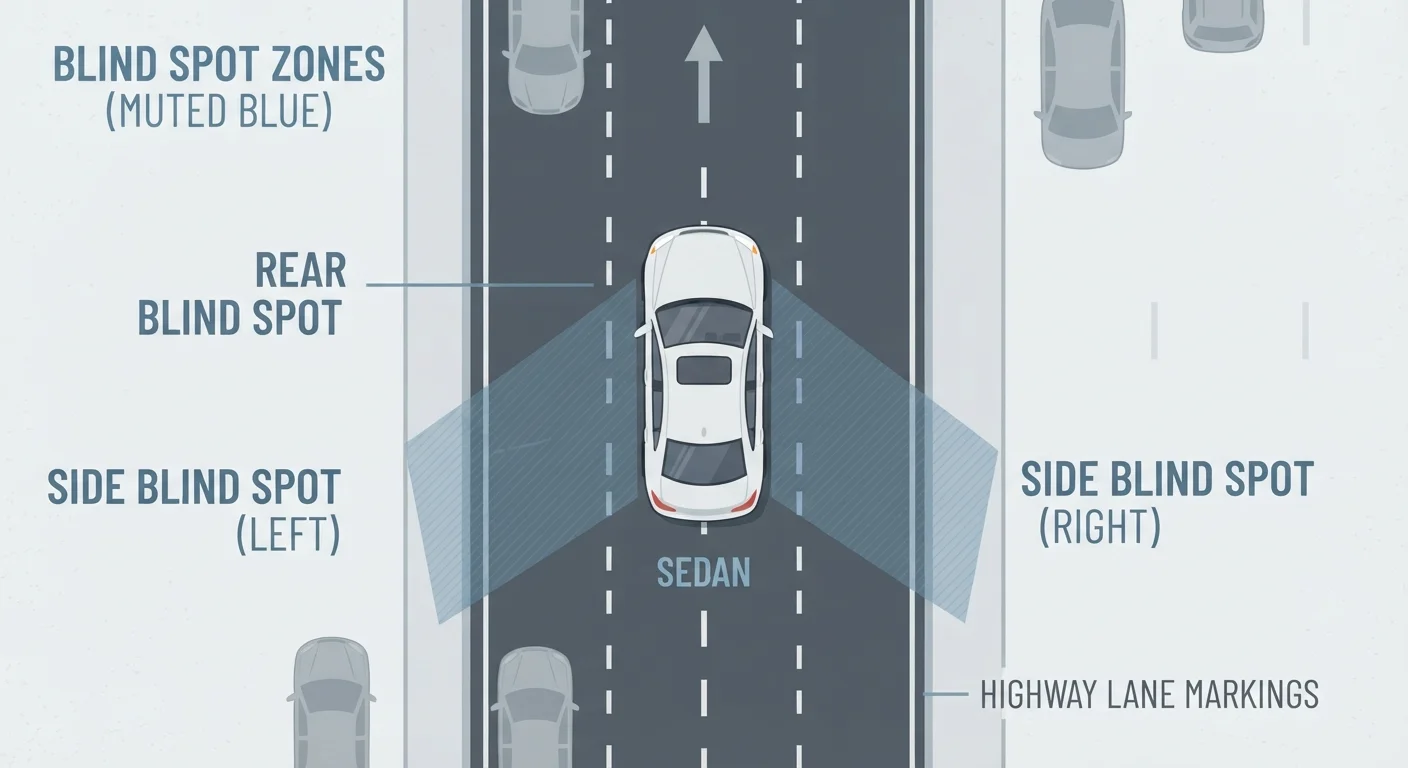
Photo: FaqsDrive.com | Smart Way To Search editorial
—— In This Article
Key Takeaways
- Every vehicle has blind spots on both sides, at the rear, and directly in front - not just to the left and right.
- Larger vehicles like SUVs and pickup trucks have significantly bigger blind zones than sedans.
- Mirrors set to the factory default often leave unnecessary overlap and widen blind spots unnecessarily.
- A quick shoulder check before every lane change catches what mirrors miss.
- Blind spot monitoring systems assist awareness but should not replace active mirror checks and head turns.
The Four Blind Zones You Actually Have
Most drivers picture blind spots as two patches beside the rear doors. The reality is more complex - and more important to understand. Every vehicle has at least four blind zones:
- Rear-quarter zones (both sides): The most commonly discussed. These sit diagonally behind the driver and front passenger and are large enough to conceal a full-size vehicle in an adjacent lane.
- Direct rear zone: The area directly behind your trunk or tailgate. Without a backup camera, this is entirely invisible without mirrors.
- Front blind zone: The area immediately in front of the hood. This matters most in parking lots and crowded intersections, where pedestrians or low-profile objects can disappear below the hood line.
The size of each zone depends on your vehicle's height, length, and window design. A sedan with large rear windows has smaller rear blind spots than an SUV with thick pillars and a high beltline. Understanding your specific vehicle's geometry is the first step toward compensating for it.
840,000+
Annual U.S. blind spot crashes
The National Highway Traffic Safety Administration has attributed over 840,000 crashes per year to blind spot-related lane changes.
20+ ft
Rear blind zone on full-size pickup trucks
A full-size pickup truck's rear blind zone can extend more than 20 feet behind the tailgate, according to vehicle safety research.
~300%
Larger blind zones in SUVs vs. sedans
Safety research has found that taller vehicles with higher beltlines and thicker pillars can have blind zones several times larger than those of a compact car.
How Mirror Position Changes What You Can See
Factory mirror settings are not optimized for blind spot coverage. Many drivers position side mirrors to show a generous strip of their own vehicle's flank - which is familiar and reassuring, but redundant. You already know your car is there.
A more effective approach, supported by guidance from safety researchers, is to angle each mirror outward until your own vehicle's edge is just barely visible. This redirects mirror coverage into the actual danger zone alongside you. Here's the general method:
- Sit in your normal driving position before adjusting.
- Adjust the driver's side mirror until you can just see the left edge of your car.
- Repeat on the passenger side, leaning slightly toward the center console first to simulate the angle you naturally glance at that mirror.
- Set the rearview mirror to cover the full rear window without obstruction.
After this adjustment, there will still be a gap between what your rearview mirror covers and what your side mirrors cover. That gap - however narrow - still requires a physical head turn to check before changing lanes.
Test Your Mirror Adjustment Before Driving
After resetting your mirrors, have a helper walk slowly around the rear of your vehicle while you watch from the driver's seat. Note where they disappear from mirror view and reappear in your peripheral vision. That gap is your actual blind zone - knowing its width helps you judge when a shoulder check is most critical.
The Shoulder Check: Why It Still Matters
Even with mirrors correctly set, a quick glance over your shoulder toward the rear-quarter zone remains the single most reliable way to confirm a lane is clear. This is called a shoulder check, and it takes less than a second.
The habit breaks down in two common ways: drivers skip it entirely when they feel confident, or they look but don't actually focus - glancing without truly registering what's there. Both are forms of the overconfidence that underlies many lane-change collisions. For more on these patterns, see common assumptions that lead to crashes.
Shoulder checks matter even more in low-visibility conditions. Reduced contrast between vehicles and backgrounds - in fog, rain, or darkness - makes it harder for mirrors alone to reveal a vehicle moving in your blind zone. Wet and foggy conditions change how you should manage all aspects of visibility, including blind spot awareness.
Technology Assists - But Doesn't Replace - Awareness
Blind spot monitoring (BSM) systems use radar sensors mounted in the rear bumper to detect vehicles traveling in adjacent lanes. When a vehicle enters the monitored zone, a warning light appears in or near the corresponding mirror, sometimes paired with an audible alert if you activate a turn signal.
These systems are genuinely useful. But they have documented limitations:
- Most systems have a detection range of roughly 10 to 20 feet - vehicles approaching at high relative speed may not trigger the alert early enough.
- Sensors can be affected by heavy rain, snow buildup on the bumper, or sensor misalignment after a minor collision.
- Cyclists and pedestrians on foot may fall below the detection threshold of some radar-based systems.
BSM Systems Require Sensor Maintenance
Blind spot monitoring sensors are typically embedded in the rear bumper. A minor parking lot scuff or a DIY bumper repair can knock them out of calibration. If your BSM warning light stays on or the system behaves erratically, have the sensors inspected by a qualified mechanic. A malfunctioning system that gives false confidence is more dangerous than no system at all.
After-dark driving compounds blind spot risks because vehicles in your blind zone are harder to detect in mirrors even when correctly set. Treat BSM alerts as a helpful secondary check, not a replacement for your own active scanning.
Frequently Asked Questions

Automotive Basics Editorial Team
Automotive Basics Editorial Team is the collective byline for our editorial team and contributor network. Articles published under this byline or an editorial pen name are researched, written, and reviewed according to our editorial standards for clarity, consistency, and independence before publication.
View author profile