
Roundabouts vs. Traditional Intersections: Who Wins on Safety?
Roundabouts confuse many American drivers, but the safety data is clear. See how the two intersection types compare.
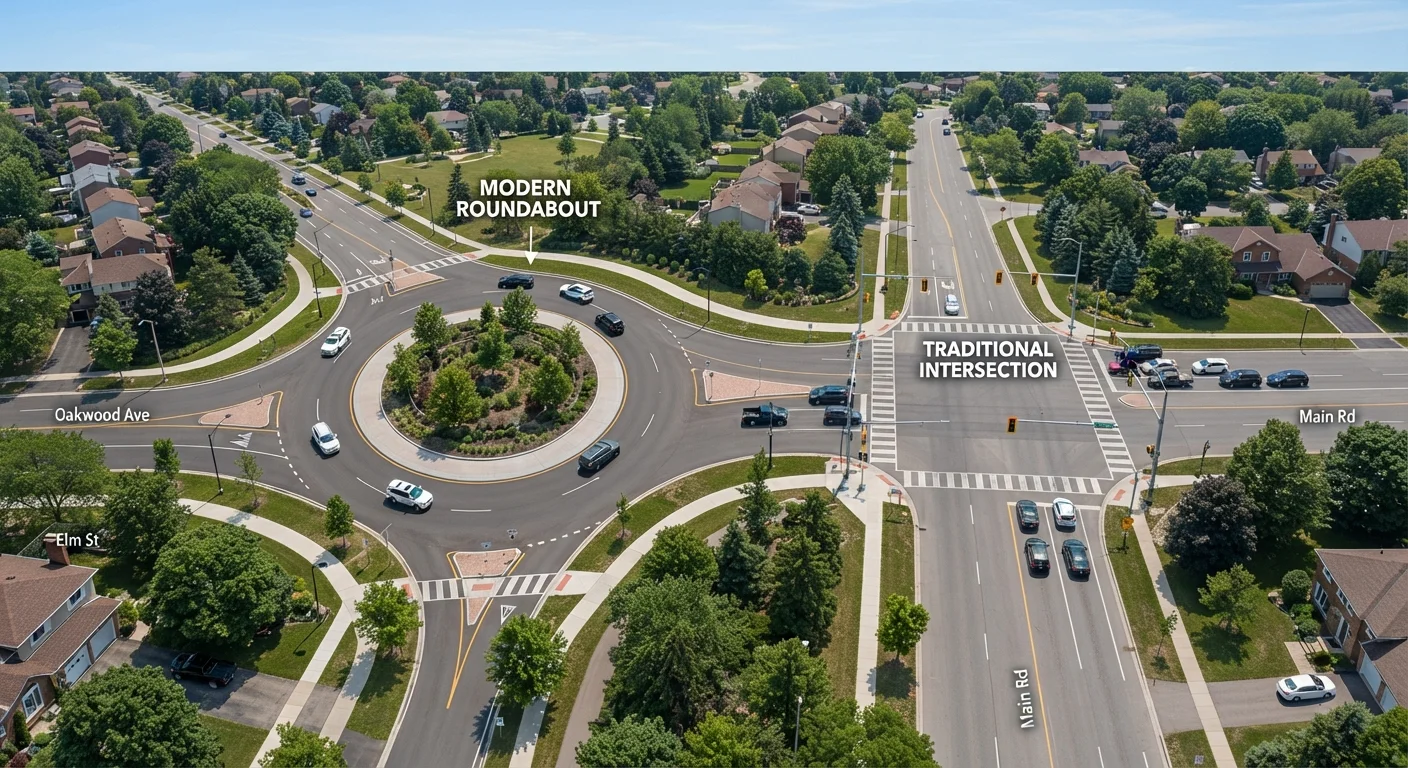
Photo: FaqsDrive.com | Smart Way To Search editorial
—— In This Article
Key Takeaways
- Roundabouts reduce fatal and injury crashes significantly compared to traditional signalized intersections.
- Eliminating left-turn conflicts is the primary reason roundabouts are safer by design.
- Slower entry speeds at roundabouts mean crashes that do occur tend to be less severe.
- Pedestrian safety at roundabouts depends on proper crosswalk design and driver awareness.
- Knowing how to yield correctly in a roundabout is the single most important driving skill to practice.
Why Intersection Design Matters for Driver Safety
Intersections are among the most dangerous spots on any road network. According to the Federal Highway Administration (FHWA), a significant share of all traffic fatalities and injury crashes in the United States occur at or near intersections. The way an intersection is designed - not just how carefully you drive - shapes how likely a serious crash is to happen.
Two types dominate American roads: the traditional intersection (controlled by stop signs or traffic signals) and the modern roundabout (a circular junction where traffic flows continuously in one direction). Many drivers feel confident at traditional intersections and confused at roundabouts. But familiarity and safety aren't the same thing. Understanding the design differences helps you drive smarter at both.
Just as false assumptions behind the wheel contribute to crashes at intersections of all kinds, understanding road design helps replace guesswork with informed awareness.
How the Two Intersection Types Compare
The core difference comes down to conflict points - the locations where vehicle paths cross or merge. A standard four-way intersection has up to 32 vehicle conflict points, including high-speed, right-angle collisions (the notorious T-bone crash). A roundabout, by contrast, reduces those to just 8 conflict points, and the circular flow eliminates left-turn crossings entirely.
| Roundabout | Traditional Intersection | |
|---|---|---|
| Vehicle conflict points | 8 | 32 |
| Left-turn crossing conflicts | None | Common and high-risk |
| Typical entry speed | 15-25 mph | Up to 50 mph |
| Fatal crash reduction (vs. signal) | ~90% lower (FHWA data) | Baseline |
| Pedestrian crosswalk clarity | Set back, less intuitive | Familiar, signal-guided |
| Driver familiarity (US) | Lower - still uncommon | High - widely understood |
| Traffic flow during off-peak hours | Continuous, no wait | Dependent on signal timing |
Speeds also differ dramatically. Drivers entering a roundabout must slow to roughly 15-25 mph, while vehicles at traditional intersections may be traveling at 40-50 mph when the light turns. Physics matters here: crash severity increases with speed. A lower-speed sideswipe in a roundabout is far more survivable than a high-speed right-angle collision at a signalized intersection.
~90%
Reduction in fatal crashes
The Federal Highway Administration reports approximately a 90% reduction in fatalities at intersections converted from signals to roundabouts.
75%
Fewer injury crashes
FHWA research consistently shows a roughly 75% drop in injury-producing crashes following roundabout conversions.
32 vs. 8
Conflict points: signal vs. roundabout
A standard four-way signalized intersection has up to 32 vehicle conflict points; a single-lane roundabout reduces that to just 8.
The Safety Data: What Research Shows
The FHWA has studied hundreds of intersection conversions from traditional signals to roundabouts. Their findings are consistent: roundabouts are associated with a roughly 35-47% reduction in total crashes, a 75% reduction in injury crashes, and approximately a 90% reduction in fatal crashes at converted locations. These are not marginal improvements - they represent dramatically different outcomes for the drivers and pedestrians who use those intersections every day.
Why such a large difference? It comes back to conflict-point geometry and speed. Angle crashes - the kind that happen when one driver runs a red light and strikes another vehicle broadside - are almost entirely eliminated in a roundabout. There is no red light to run, and there is no opposing left-turn movement to misjudge.
Practice Roundabouts When Traffic Is Light
If roundabouts feel unfamiliar, seek one out during a low-traffic time - early morning on a weekend, for example - and practice the yield-and-enter sequence several times. Muscle memory built in a low-pressure environment makes the same maneuver feel natural when traffic picks up. You can also look up your state's DMV roundabout guidance online for diagrams and video walkthroughs before you go.
It's worth noting that roundabouts aren't universally superior in every context. Locations with very high pedestrian volumes, particularly those serving people with visual impairments, require careful crosswalk design to maintain safety benefits. In these cases, the design and signage of the roundabout matter as much as the layout itself.
How to Drive Roundabouts Safely
Most American drivers learned to drive on traditional intersections, so roundabout anxiety is understandable. The rules, however, are straightforward once you internalize them.
- Yield to circulating traffic. Before entering, you must yield to vehicles already in the circle - not stop unless there is traffic, but yield.
- Slow down on approach. Reduce speed well before the yield line, not at it. Watch for the dashed yield markings painted on the road.
- Signal your exit. Use your right turn signal as you pass the exit just before yours, so other drivers and pedestrians know your intentions.
- Watch for pedestrians at crosswalks. Roundabout crosswalks are set back from the circle itself. Yield to pedestrians both entering and exiting.
- Never stop inside the circle. If you miss your exit, continue around and take the next opportunity safely.
These habits connect directly to the kind of attentive driving that prevents crashes in all settings. Speed management, for instance, is as relevant at a roundabout as it is on any road - see common speed limit misconceptions for more on why posted limits exist for good reason.
Never Stop Inside a Roundabout Circle
Stopping inside the circular lane - unless an emergency requires it - creates a hazard for every driver behind you. If you miss your exit or feel uncertain, keep moving at a slow, steady pace and take the next exit or complete the full loop. Hesitation and sudden stops are among the most common causes of minor roundabout collisions.
Making the Right Call at Either Type
Whether you're approaching a roundabout or a signalized intersection, the safest behavior shares a common foundation: reduce speed early, scan all directions, and never assume other drivers will do what you expect. Driver assumptions are one of the leading contributors to preventable collisions at intersections of every design.
Traditional intersections still dominate most American roads and will for the foreseeable future. Knowing how to navigate both types - and understanding why roundabouts handle certain crash types better - makes you a more adaptable, safer driver overall. The data supports roundabouts as a strong safety improvement, but no road design substitutes for an attentive driver behind the wheel.

Automotive Basics Editorial Team
Automotive Basics Editorial Team is the collective byline for our editorial team and contributor network. Articles published under this byline or an editorial pen name are researched, written, and reviewed according to our editorial standards for clarity, consistency, and independence before publication.
View author profile