
Synthetic vs. Conventional Motor Oil: What the Difference Actually Means for Your Engine
Synthetic and conventional oil aren't interchangeable for every driver. Learn what sets them apart so you can make an informed choice with your mechanic.
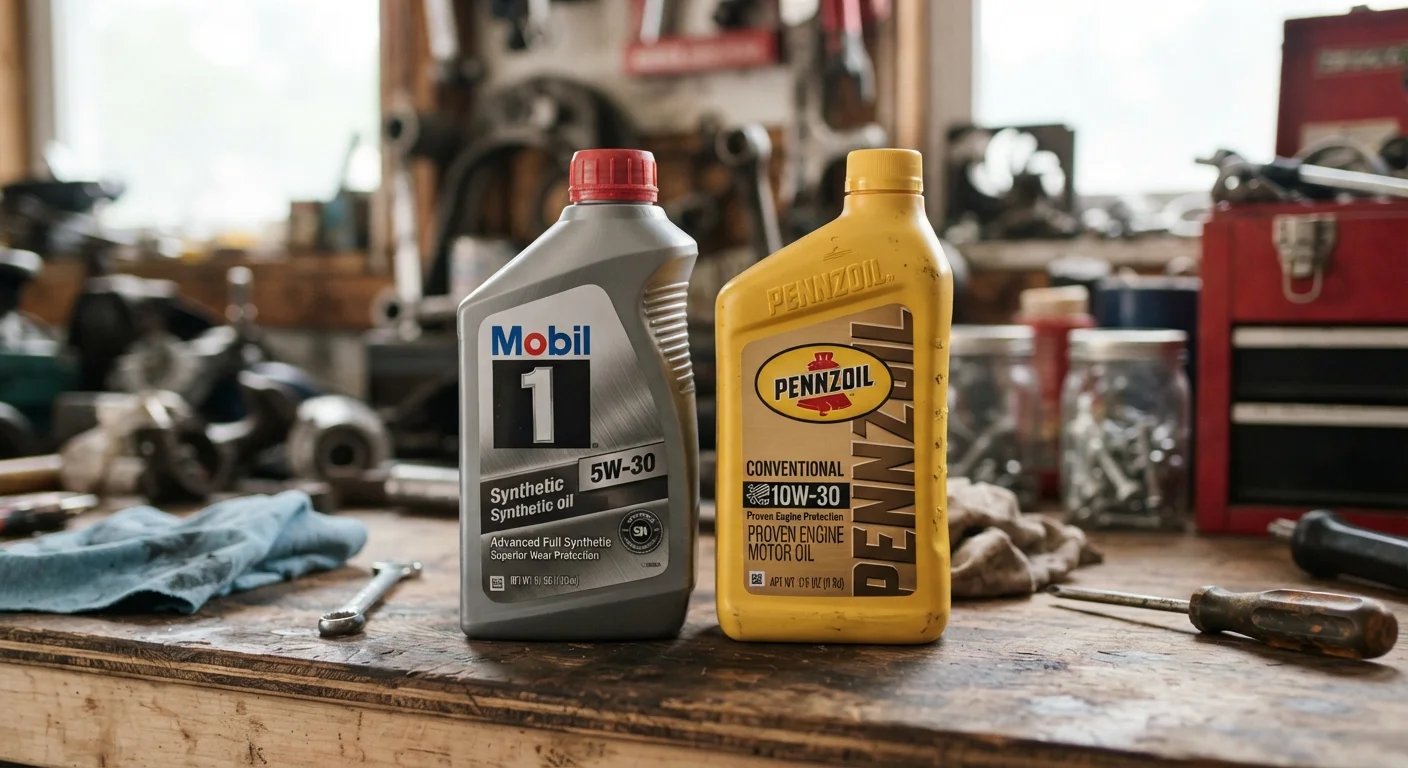
Photo: FaqsDrive.com | Smart Way To Search editorial
—— In This Article
Key Takeaways
- Synthetic oil is chemically engineered for more consistent molecular structure, while conventional oil is refined from crude petroleum.
- Synthetic oil generally lasts longer between changes, often 7,500 to 15,000 miles depending on the vehicle and driving conditions.
- Conventional oil can still be appropriate for certain older engines or vehicles with specific manufacturer guidance.
- Your owner's manual is the authoritative source for which oil type your engine actually requires.
- Switching from conventional to synthetic is generally safe, but consult a mechanic if your vehicle has high mileage or known oil leaks.
How Each Type of Oil Is Made
Motor oil's primary job is straightforward: reduce friction between moving metal parts inside your engine and carry away heat and contaminants. But not all oils get to that job the same way.
Conventional motor oil starts as crude petroleum pumped from the ground. It's refined to remove impurities and blended with additives, but because it comes from a natural source, its molecules vary in size and shape. That inconsistency is minor under normal conditions but becomes more significant under stress.
Synthetic motor oil is chemically engineered - built molecule by molecule in a laboratory to achieve a uniform structure. The result is an oil that behaves more predictably across a range of temperatures and pressures. Most synthetics also start with some petroleum base, but the refining and engineering process is far more controlled.
For a deeper look at how oil grades and viscosity ratings work alongside this question, see our plain-language breakdown of engine oil for everyday drivers.
| Criterion | Synthetic Motor Oil | Conventional Motor Oil |
|---|---|---|
| Origin | Chemically engineered | Refined from crude petroleum |
| Molecular consistency | Highly uniform | Variable |
| Cold-weather performance | Flows faster in low temps | Thickens more in cold |
| Heat resistance | Breaks down more slowly | Degrades faster under heat |
| Typical change interval | 7,500-15,000 miles | 3,000-5,000 miles |
| Cost per quart | Generally higher | Generally lower |
| Suited for older engines | Usually fine; check with mechanic | Often preferred |
Real-World Performance Differences
The chemistry gap between the two oils shows up most clearly in three situations: cold starts, high heat, and extended use.
Cold starts are hard on engines because oil thickens when temperatures drop, slowing the time it takes to reach critical engine parts. Synthetic oil flows faster in the cold, providing earlier lubrication where it counts most.
High-heat environments - such as turbocharged engines, towing, or stop-and-go city driving - cause conventional oil to break down more quickly, losing its protective properties. Synthetic oil resists this thermal breakdown longer.
Change intervals are where the cost difference becomes more nuanced. Conventional oil typically calls for changes every 3,000 to 5,000 miles. Synthetic oil can often go 7,500 to 15,000 miles, depending on your vehicle and driving habits. Fewer changes may offset the higher per-quart price over time - though you should always follow your owner's manual, not just general guidelines.
7,500-15,000 mi
Typical synthetic oil change interval
Many vehicle manufacturers recommend extended intervals for full synthetic oil, compared to the traditional 3,000-mile guideline for conventional oil.
~40%
Engine wear occurs at cold startup
Industry estimates suggest a significant share of engine wear happens in the first moments after a cold start, when oil hasn't yet fully circulated - an area where synthetic oil has a measurable advantage.
What Your Owner's Manual Actually Says
The single most reliable guide for your vehicle is the owner's manual. Manufacturers engineer engines with specific oil types in mind, and using the wrong one - even a technically "better" one - can affect engine performance or void a warranty in some cases.
Many vehicles built in the last decade explicitly require full synthetic oil. Others allow either type. Some older engines perform better on conventional oil because their seals and clearances were designed around it - though a qualified mechanic can advise whether switching is appropriate for your specific situation.
High-Mileage Vehicles: A Special Case
If your vehicle has over 75,000 miles and has always run conventional oil, switching to full synthetic warrants a conversation with a mechanic first. Some older engines develop small seal leaks that conventional oil's slightly thicker residue has been masking. A mechanic can assess whether the switch makes sense or whether a high-mileage-formula oil is more appropriate.
Understanding your oil type is just one piece of knowing your vehicle. Our transmission types comparison covers another core system that varies significantly between vehicles.

Automotive Basics Editorial Team
Automotive Basics Editorial Team is the collective byline for our editorial team and contributor network. Articles published under this byline or an editorial pen name are researched, written, and reviewed according to our editorial standards for clarity, consistency, and independence before publication.
View author profile